Lunch
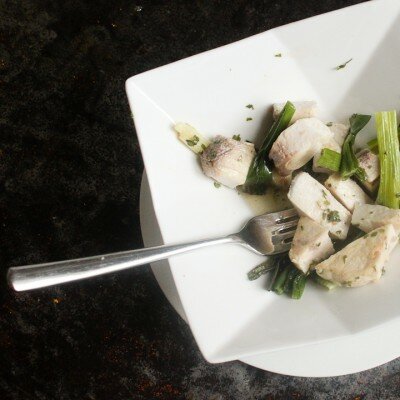
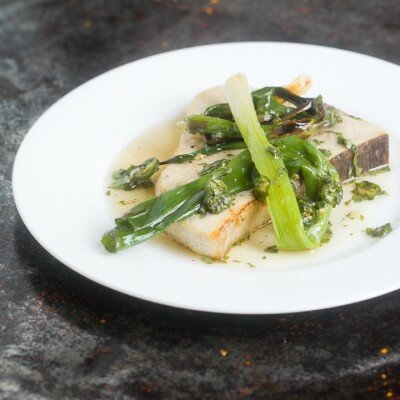
Swordfish and Scallion Salad
 This was a meaty weekend, starting with a tower of various pig and cow parts brought in from Hill Country Friday night, and concluding with a Peking duck from Peking Duck House. Aside from a bellyful of fatty flesh, I came away, strangely, with a deeper understanding of the vegetarian life.
Vegetarians, I realized, are like scientologists, dwelling in, but not of, the surrounding world. You watch everyone eat meat, yet you poke through a salad or a veggie burger, or, in the latter case, strapped to an e-meter (is there a hyphen in there…not sure). Especially as winter turns to spring and there’s nothing better than a nice walk around the neighborhood. Restaurants unpack the tables and chairs stored since last year and set them up on the sidewalks; I can only imagine the torture of walking up Lafayette past the swept open windows and doors of Soho Park knowing you’re forbidden to sample the burger.
Yet there is, I suppose, a sense of community (see: A.A.); vegetarians united. Alas, such a group doesn’t exist for the haters of tuna salad; this is true loneliness, anomie at its most intense. I take solace, however, in the knowledge that I’m right, and that someday the world will come around to the fact that fish packed into a can, potentially for years, is incorrect.
When it comes to fish, the most frequent adjective is “fresh”: right from the sea, the “daily catch”, “day boat scallops”, line caught this and that. I like my sushi as fresh as possible; if I preferred an older product I’d eat, well, canned tuna. I also prefer my fish clean smelling, with only a faint briny odor. For those who prefer otherwise, there’s always canned tuna, which, when opened, emits the nauseating aroma of cat food.
Objection #3: color and texture. Overcooking tuna is a basic cooking no-no. The fish turns the color of molding clay and acquires the texture of compressed pencil shavings.
If it’s a seafood salad you’re after, chunk up a piece of cooled, recently cooked fish and toss it with some sort of vinaigrette. When thinking up a seafood salad, the best thing to do is close your eyes and imagine you’re on a the beach on a sunny day, thoughts of lunch floating through your mind like the waves washing over your toes. Unless the beach is off Chatham in the middle of great white season in which case it’s wiser to focus on something other than lunch.
A shellfish salad, perhaps, complete with mussels and clams and squid, or of course, a salad nicoise. Which brings me back to tuna. Salad nicoise is a perfect example of a correctly prepared ingredient bathing in its correct context. Tuna, seared rare, sliced, with a bunch of Meditterraneany stuff. Swordfish, while not the most exciting fish, is almost genetically engineered for salads: the firm flesh doesn’t collapse when tossed with a dressing or pierced by a fork. And it’s bland enough to take on any desired flavor. It also doesn’t come from a can, which is nice when it comes to fish.
Swordfish Salad w/ Thai Dressing and Broiled Scallions
Serves 4
1 ½ pounds swordfish
2 bunches scallions, trimmed
sliced mint
olive oil
salt and pepper
For the Dressing:
¼ cup fish sauce
2 tablespoons water
2 tablespoons sugar
1 tablespoon rice vinegar
juice 1 lime
1 minced garlic clove
1 minced fresh red chile
- Rub fish all over with a bit of olive oil and lay on rack over a foil-covered baking sheet. Season both sides with salt and pepper. Toss the scallions with oil. Preheat the broiler. Place on a rack with scallions. Place on a rack just under the heat. Depending on thickness, the fish will take 6-7 minutes, flipping once, and scallions 3-4. You want the veg just cooked through and just a little browned, not charred. Remove, let cool and refrigerate. When cold, cut fish into ½ inch pieces and the scallions into 1-inch lengths.
- Whisk the dressing ingredients until the sugar completely dissolves. Gently toss the fish and scallions in a bowl with the dressing and mint. Season as desired and serve.
Yorkshire Puddings w/ Foie Gras and Strawberry Preserves
 Cheetos are a miracle of science. Consider the recent NYT magazine cover story on food conglomerates and their efforts to hook the public on their products. Of the chips, processed lunch meats, and sugary sauces, I was most impressed with the Cheeto. Not only does it crunch, but it pleasingly melts in the mouth, wherein lies a key added benefit: we tend to think airy, delicate foods are harmless. And so we keep dipping our orange hands into the Cheeto bag.
A morsel that both dissolves and addicts: genius. The first Cheeto emerged from a bubbling test tube, huddled over by a mob of lab-coated food scientists. Like a novel, it transformed from a dreamy vision into a real live object. But in the obsession with all things modern (see ipad, etc.), we lose sight of the past and the fact that all culinary history is full of experimentation.
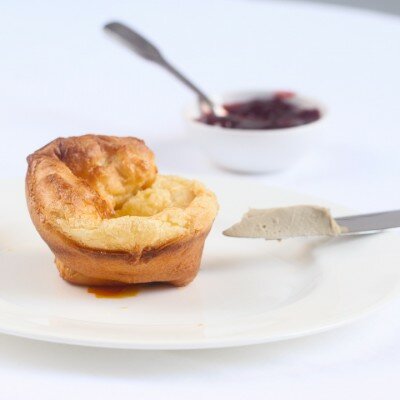
Take Yorkshire pudding, for instance. As a rule, any expanding food, be it a Cheeto, Yorkshire pudding, or a loaf of bread, is the product of trial and error, in other words, the scientific method. A tiny amount of batter ladled into a hot muffin tin blows up into a golden, yummy balloon. The first gal to crack open the oven and witness this event must have fainted right into her tub of freshly churned butter.
Cheetos and Yorkshire Pudding: pools of liquid puffed up into addictive treats. Both products of food experimentation, the former was created with the intent of hooking consumers. Scientists tested sugar, salt, and crunch metrics with the precision of researchers hunting for a cancer cure.
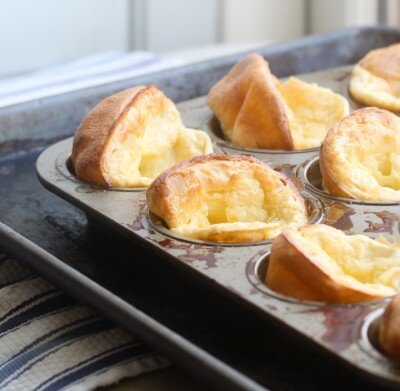
Yorkshire Pudding may not be the perfect food (to my mind, the Dorito is unsurpassable), but they’re honest, successful and absurdly simple examples of kitchen chemistry. Fresh out of the oven, these things are plenty addicting, but if you want to be like the Cheeto guy, serve them as we do here, with a spoonful of foie gras mousse and strawberry preserves.
Yorkshire Pudding w/ Foie Gras and Strawberry Preserves
Makes about 12 Y.P.’s
1 cup flour
4 eggs
1 ¼ cup milk
pinch salt
canola oil
foie gras terrine
strawberry preserves
1. Preheat oven to 450.
2. In a medium bowl, whisk salt and flour. Whisk in eggs until very smooth. Whisk in half the milk, then the remaining half. Transfer to a measuring cup and let rest.
3. Add a teaspoon of oil to each compartment of a 12 tin muffin pan. Place in oven until oil is extremely hot. Swirl around carefully.
4. Fill muffin tins about ¾ full. Bake about 15 minutes until golden and puffy. Serve with foie gras and jam.
Warm Cucumbers with Nori Dressing
Intro to a duck a l’orange recipe, source to be named later:
“This classic dish displays all the talents of the saucier, a position normally reserved for the most qualified cook in the kitchen. Duck a l’orange brings out his talents to combine three distinctly different flavors.”
Given the dish (dated) and the pedantic tone, you’d think perhaps Escoffier or a cooking school textbook (I know it sounds like ours, with its soufflé and mousse addiction). But it’s from the Balthazar cookbook, one of our favorites, for its food clear directions, and structure, but moreso its honesty: the dishes seem simple but spring from years of toil, a fact which, despite the seeming simplicity of the recipes, comes through loud and clear.
Like the Federer forehand, the Balthazar book embodies one of my favorite sayings: “he makes it looks easy”. It’s a good measure of excellence; if something looks like a breeze, it’s probably exactly the opposite. Of course, it goes around and around: what looks easy should be easy and thus generally doable.
But it’s not, which is where the obnoxious American enters the picture. The football fan screaming at that bastard who “somehow” fails to catch a badly overthrown ball. The superhuman leap, which leaves the player’s knees hanging in the air ready to be torn off by an angry giant, is forgotten. Or the restaurant critic reaming a chef who fails to produce a perfect plate of food; the dance critic wondering how a ballerina could have slipped.
The unfortunate reality is that excellence is the result of hard work. In this respect, good cooking is deceptive: tasty dishes with a limited ingredient list, are often the product of more blood sweat and tears than something molded, stuffed, wrapped, braised, sautéed, chilled, sliced, and glazed with aspic.
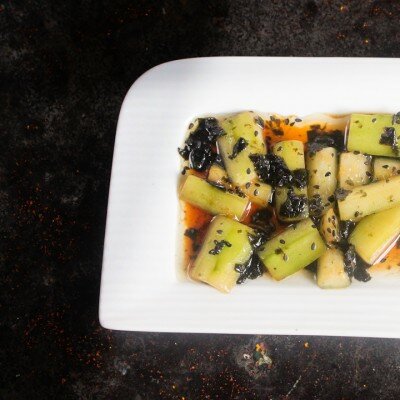
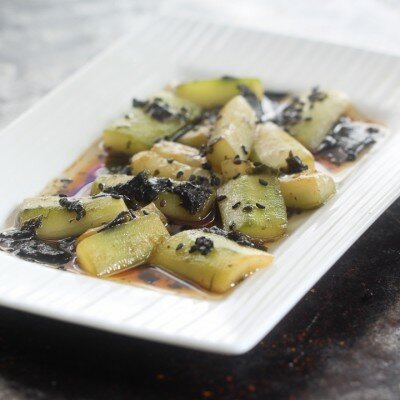
The sauce in this recipe is really good; it pairs perfectly with a quick cucumber sauté. We got it from, the Japanese chef Tetsuya Wakuda, who spoons the stuff over rare salmon. It’s a simple mixture, or should I say, he makes it look simple, which is high praise indeed.
Warm Cucumber With Nori Dressing
Serves 4 as a side dish
2 seedless cucumbers
1 sheet nori crumbled into small flakes
1 ½ tablespoons soy
2 tablespoons mirin
¼ cup rice vinegar
1 tablespoon sesame oil
1 teaspoon sugar
¼ cup olive oil plus 2 tablespoons
pinch salt
1 tablespoon black sesame seeds
- Peel and halve the cukes lengthwise. Remove seeds with a spoon. Slice halves widthwise in 1 inch pieces then cut the sections in half to form pieces about 1 by ¼ inch. Reserve in a bowl.
- Make the dressing: in a medium bowl, whisk the ingredients together except for the nori and the 2 tablespoons olive oil. Stir in the crumbled nori. Let sit ½ hour.
- Heat the two tablespoons oil in a large sauté pan over medium high heat. When hazy, add the cucumbers and saute, stirring occasionally, for about 2 minutes or until warmed through and tender but not overcooked. They should have a bit of a bite.
- Pour the warm cucumbers into the bowl with the dressing, toss, and serve on a platter.
Bone Marrow and Anchovy Crostini
I begin packing his school lunch when he presses the elevator button. By the time the elevator arrives, the meal is sealed up in his little frog knapsack, and we’re out the door. And we live on the third floor. If any of the major food groups are represented, it’s been a success. I shiver to think of the teachers as they watch him pull out a piece of white bread, goldfish, and a chocolate chip cookie.
But starch is an important part of life, and thus he’ll have a firm head start on those children with bags of mini carrots and organic ham. There is, we’re told, a wide variety of foods out there. Not eating correctly and choosing according to our bodily needs is wasteful, ignorant, and lazy. Or so they say. But a diet of pure fat can be even more sophisticated and clever.
The options are staggering: dairy (cream/milk/cheese/butter/etc.); animal (bacon and every other pleasant item); oils (preferably used to fry stuff); and the healthy area (avocados/nuts, preferably pureed with extra oil in a pesto). Everyone has a favorite. For instance, one might enjoy cream, say in a bowl of clam chowder (ingredients: bacon and cream), or an equally creamy potato gratin (ingredients potatoes and cream).
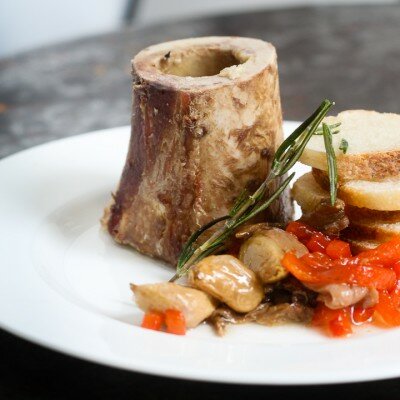
And then there are the neglected fat delivery systems, such as offal (sweetbreads and liver). And like the pimpled teen Donkey Kong champ, marrow fat is king of offal-fat land. It’s a strange item calling for a strange eating method: stick a tiny spoon into a roasted bone hunting for gelatinous ooze. It’s like mining for gold with a toothbrush . Some of the fat melts and oozes into a puddle in the hot pan while the rest remains inside the bone, soft and unctuous.
The best part of marrow fat, and why it is so prized by chefs, is its ability to donate, in one tiny spoonful, both an interesting flavor as well as a fatty mouthful, to a range of dishes, from salads to pasta, and cooked meats and fish. In this sense, it’s like cream or butter, which, let’s face it, added in small (or large) amounts, improve everything, from soups to sauces or shampoos. But because it has an actual flavor, marrow fat, if you can get your hands on it, can be even more useful.
As I did yesterday, this morning I pried four congealed leftover dumplings and threw them in the kid’s lunchbox for a balanced meal of fat and carbs. When I get the energy, I’ll bring in molten marrow fat for the class snack. It’s a valuable introduction to the wonderful world of fat.
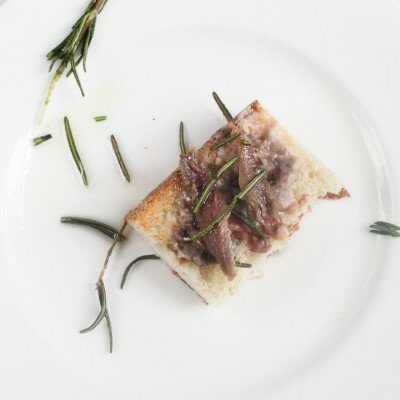
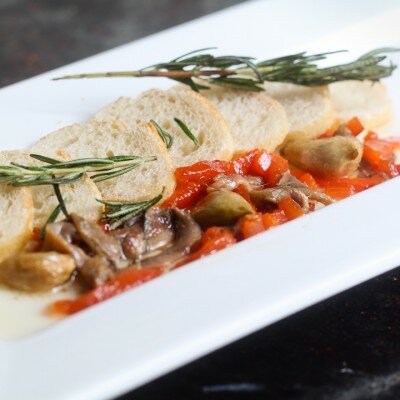
(NOTE: you usually spoon marrow over a crostini and leave it at that, but I draped a few anchovy fillets over the top. It’s pretty darn good.)
Bone Marrow and Anchovy Crostini
Makes enough for at least 20 crostini
5 large marrow bones
few tablespoons canola oil
4 large sprigs thyme, two reserved and leaves minced finely
20 anchovy filets (salted)
1 thin baguette (ficelle)
cracked fresh black pepper
1. Preheat oven to 400.
2. Coat a small pan with oil, season bones all over with a bit of salt and pepper and stand in the pan. Roast for about 15-20 minutes, depending on size. The interior should be thoroughly soft and melting when pierced. Remove to a platter, add two of the thyme sprigs to hot fat in the pan and fry until lightly browned, add to plate with bones.
3. Meanwhile, slice bread into thin (no more than ¼ inch) slices and arrange on platter with bones, fried thyme, and demitasse spoons for spreading marrow. Drizzle hot fat in pan over the bread as well as the minced fresh thyme.
4. Serve immediately with anchovy filets.
Broccoli Stem and Floret Salad
A culinary student colleague, returning from an internship at Daniel told me the experience was generally crummy. One can only tolerate being called a jackass in French for so long. Most astonishing was the sheer waste: a celery stalk is reduced to a precisely measured pile of brunoise barely able to fill a demitasse spoon. A parsnip yields a few wispy threads destined to be dropped ever so delicately into the fryer and cooked to the color of the late afternoon sun.
A restaurant is medieval in structure, gentry in the front, serfs (slaves?) in the rear, which, as it happens, is chock full of period appropriate torture instruments: raging fire, boiling oil, and severe taskmasters. And the persistent fear of infiltration by a fierce power – the INS.
In another genuine touch, the cooks are fed scraps shaved from whatever feast is shipped to the paying diners. In an odd way, however, this phenomenon, the staff meal, should serve as a valuable modern day lesson to us all. Nothing is wasted; bits of veg and meats are turned into stocks and soups and stews and sandwiches and so on, most of which, due to lack of time, are pitifully flavored, but can be, in the leisurely environment of the home cook, turned into satisfying meals.
Nowadays, a chef is measured by his nose-to-tail skills; can he transform every last part of the pig into a delicious morsel. For some reason, especially at home, vegetables are not given the nose-to-tail respect; lop off the broccoli florets and chuck the stem; throw out that unused quarter of a fennel or half a shallot.
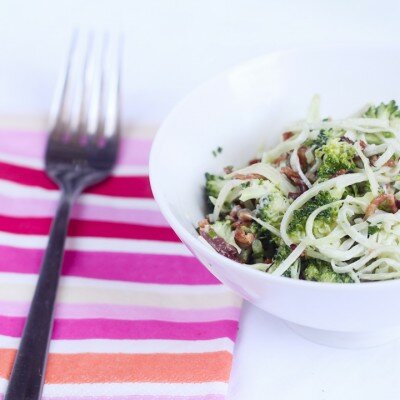
While it would be nice to read less about nose-to-tail and more about stem-to-stalk, the home chef should take a page from the restaurant kitchen and use up these bits and pieces. Stuff can be turned into pickles or relishes, chutneys, etc. And it’s a sin to dump something as worthy as a broccoli stalk, which is the moral of today’s post, the all-broccoli salad, or in chefy terms, broccoli two ways. A worthy recipe in the savvy, thrifty spirit of the modern galley workers.
(NOTE: 1. If you don’t have a mandoline, this is the time to buy one. 2. The amounts are purposely vague (you should know how you like your dressing), the only caveat being not to make it too thick and not to overdress. It’s a delicate salad, the last thing you need is soggy, heavy veg.)
Salad of Broccoli Stems and Florets
Serves 4
2 medium bunches broccoli
2 slices bacon
chives
buttermilk
sour cream
touch olive oil
salt and pepper
- Bring a large pot of salted water to boil. Have bowl of ice water nearby.
- Cut off florets into 1/2 –inch size. Using a paring knife, peel stem from end to end, removing tough exterior. Slice peeled stems into strips, ¼-inch thick and about 2 inches long, stack, then julienne. Alternatively, use a mandoline and make your life easier. Keep florets and stems separate.
- Blanch florets very briefly, no more than 30 seconds-they should still have bite. Repeat with julienned stem. Use a slotted spoon to transfer the vegetables to ice water.
- Saute the bacon and crumble. Reserve on a paper towel
- In a small bowl, whisk buttermilk and sour cream to a dressing consistency (not too thick – SEE NOTE). Add a touch of olive oil and season well with salt and pepper. Toss and serve.
Coconut Soup with Butternut Squash and Chile Sauce

Most cultures have a signature stew. I think of stew as a warm winter retreat, but even hot regions possess hot stews, leading me to ascribe equal cultural significance to stew as, say, bread or grain dishes. And since stews are liquid based, it stands to reason said liquid would be something indigenous. Hence the French – if only as an excuse to drink while cooking – use wine, and Thai/Vietnamese favor coconut milk. The latter is of interest to us today.
Not only is coconut milk rich, but the truly authentic curry recipes go a step further, calling for coconut cream. Cream or no cream, these curries never contain just “a touch of cream”, as waiters like to say. Rather, as with a true New England clam chowder, to eat these dishes is to consume spoonful upon spoonful of straight, simmered cream.

A good chef has a delicate relationship with his can of coconut milk: not too much, not too little. A poor chef looks at a can of coconut milk and sees an excuse not to cook and develop flavors but rather a shortcut in a can. And so you find the clumsy bowl of greasy white milk requiring some considerable fishing to locate a morsel of chicken or floret of broccoli.
The exception is coconut soup, a perfect representation of the phrase “it is what it is”. The soup is flavored simply with fish sauce and garnished with a healthy handful of veg (we used butternut squash), preferably something colorful enough to offset the white broth. Ironic that the perfect embrace of coconut milk exists in soup, rather than stew form, but cooking works in mysterious ways.
As a not inconsiderable aside, whatever you make with coconut milk needs a sharp condiment (unless it’s dessert) to fend off its richness. Here we made a simple chile sauce, but pickled cucumbers, herbs, and so on, would work well.
(NOTE: If you don’t live near a Thai grocery and thus can’t bike over for a few handfuls of tiny bird chilies, use whatever hot chile you can find.)
Coconut and Butternut Squash Soup
Serves 4 (with rice)
2 pound butternut squash diced (1/2 inch)
2 cups coconut milk
2 cups chicken broth
3 tablespoons fish sauce
Chile Sauce (below)
1. Combine squash, coconut milk and broth in a pot and simmer until the vegetable is tender. Season with fish sauce and serve with Chili sauce.
Chile Sauce
½ cup scuds (tiny Thai chilies) or a few Serrano chilies
1 cup fish sauce
1. In a food processor (a mini one works well here), pulse the scuds (seeds included) to a slightly chunky paste. Add to a bowl and pour over the fish sauce. Serve. Stays covered in fridge for quite a while, decreasing in heat over time.
Homemade Sausage and Peppers

Thomas Keller says he keeps two things on the stove at all times: salt and acid, acid being citrus, or more likely, some kind of vinegar. Rather than, say, pepper, which adds a unique flavor, salt and vinegar act as a welcome air current to bird, carrying and intensifying existing flavor. A pinch of cumin makes a dish tastes a bit like, well, cumin. But a splash of balsamic can balance, or round out the picture, cutting through the fattiness of a steak or creamy sauce.
In addition to vinegar, Keller also savours publishing the occasional punishing recipe. Like a tennis serve, the mechanics may seem simple, but take a long time to master. Such is the case with his famous salmon tartare cones, which took me about a year to conquer. (A tip: when the butter starts bubbling, it’s ready to flip and mold.)
A perfect sausage is a like a speedy, accurate, tennis serve, requiring more than a little practice. We make our own fresh sausages around here, thanks to Pino the butcher, the Meat Hook’s cheap casings, and a streak of ocd. Usually we encounter the occasional split casing, or, more typical, a puff of meat popping out from both ends while in the frying pan.

Only yesterday did we produce flawless links. Way back, we learned about pricking out air holes, but the final key, it turns out, is to spin the ends vigorously while forming fresh links. That ensures a nice tight tip guaranteed not to burst.
But while it’s nice to master tricky recipes, it’s even nicer to broaden your touch, your food aptitude. Which is where the vinegar comes in. We stole this sausage dish from Andrew Feinberg via the doorstop-sized CoCo cookbook, down to the sautéed peppers served alongside the fried links. Sausage and peppers is pretty common, but, due to a tiny splash of balsamic, these peppers were perfect. The vinegar lightened the pork and brightened the whole plate. Keller (and, of course, Feinberg, would approve.
If there’s a lesson here, it’s not to be discouraged by tricky recipes. Having salt and vinegar within arms reach is half the battle.
(NOTE: get a kitchen scale. Curing salt optional, but they retain freshness and color. These freeze well. Also, when you grind, run through large, then fine die. Also (#2) make sure the butcher (if you’re making links) gives you casings packed in salt-they last a year. If you already possess a Kitchen Aid and have a bit of time, don’t be a schmoe: get the grinder/stuffer accessories. We added a bunch of directions on the processing-the book is sort of for the already-chef.)
Homemade Sausage and Peppers (From Coco and adapted from Andrew Feinberg)
Makes about 20 links (or a bunch of patties)
For the sausage:
Hog casings
4 ½ pounds fatty pork butt
½ pound pork belly
1/3 pound chopped parmesan
4 cloves chopped garlic
2 tablespoons salt
black pepper
5.6g curing salt
1. clean casings (see NOTE). Soak in a bowl of running water and run water through them several times. Make sure not to tangle.
2. Grind ingredients (see NOTE). Stuff casings – this probably takes 2 people – one to feed, the other to hold.
3. Prick all over with a sharp needle or some such device to pop air bubbles. Twist into links-turn several times. Freeze or use as desired.
For the peppers:
2 red bell peppers, cleaned, in ½ inch dice.
Olive oil
2 tablespoons balsamic vinegar
Salt and pepper
To finish:
1. Warm about 2 tablespoons olive oil in a large pan over medium high heat. Add peppers and let fry, untouched until lightly charred, then toss and cook till soft. Add balsamic vinegar and toss until peppers are coated, season and remove.
To finish:
- Preheat oven to 350.
- Fry 4 or 5 sausages in a large pan (don’t overcrowd or they’ll steam), rolling gently to brown all sides. Remove to oven for a few minutes. Serve with peppers.
Oysters Rockefeller via Roux Jr.

There’s something captivating about the entire Roux family. I used to think it was just the brothers (see earlier post), but the mischievous gene has been passed on to the next generation, specifically the younger Michel. On his BBC show, junior cooks French classics such as pigeon with peas, fennel-stuffed bass, morel and sweetbread-filled pigs trotter, and prune-stuffed rabbit saddle. I’ve never heard of any of this stuff-always thought classic meant soufflé-but maybe these are the burgers of France.
Funny, then, that Msr. Roux chose to make Oysters Rockefeller, a quintessentially American plate of food: something I associate with robber barons and businessmen and tourists at the Oyster Bar in Grand Central. But he chose the dish because its creation requires a handful of essential kitchen skills.
An Oyster Rockefeller (let’s use the singular, though I guess you can get a bunch) is a truly gilded lily. A plump, briny oyster is nestled in a bed of creamed spinach, coated with a rich thin custard, and broiled. The result is a warm, briny cream sandwich.
Back to the basic skills. You need to emulsify (egg with oyster liquor); squeeze dry (cooked spinach); broil gently; shuck; strain through fine mesh; temper a liquid; poach oysters very lightly. Nothing complicated, but a series of delicate steps. It’s a little ballet dance where one misstep wrecks the show.
As far as consumption, I envision tuxes, the Waldorf, and cigars. But the Cape being home of the oyster, we ate them picnic tableside washed down with growlers of Cape Cod beer. Msr. Roux would, I’m sure, appreciate.
Oysters Rockefeller (approximated via Msr. Roux)
Makes 4 oysters
4 large oysters
large handful spinach
½ cup heavy cream
1 egg yolk
salt and pepper
- Shuck oysters into a bowl and reserve in the oyster liquor.
- Steam spinach in a little water until limp. Drain, run under cold water. Squeeze out as much liquid as possible and chop roughly. Place in a bowl. Fold in enough cream just to bind the spinach. Season and reserve.
- Strain oyster liquor into a small pan over low heat. Add oysters and poach 15 seconds, remove to a bowl. Reduce liquid by half, add remaining cream (about ¼ cup). Whisk egg yolk in a small bowl and incorporate into the cream as you would a custard: pour a bit of hot liquid into the egg to temper, whisking energetically. Pour mixture back into the pot over low heat, whisking, until creamy. Season.
- To finish, preheat broiler. Spoon a bit of spinach on each oyster shell. Top with an oyster, pour over the sauce. Place on a tray and broil until lightly browned. It could take a few minutes, but watch carefully. Serve hot.
Grilled Squid w/ Basil

There’s a lobster glut around here; they’re scooping them out of the Maine waters at a furious rate, surpassing demand. And so more people are eating and overcooking more lobster than ever .
Like a new store or a Gymboree, the food truck is a symbol of arrival, that people have moved into the neighborhood, or, in this case, a dish has reached ubiquity. Which explains the three cupcake trucks and stands within 100 feet of our apartment. Or, now, the lobster roll truck.
Here in Truro, on the Outer Cape, you can find a pretty good lobster roll, but more typical is the simple steamed lobster with a baked potato and maybe a basket of steamers. I never order or cook lobster any other way, or any other time of the year. To me, lobster signifies summer, baskets pulled right from the sea, pots of boiling water, cold beer, and picnic tables. Rather than chunks of it drenched in mayo, stuffed into a bun, and served from a food truck or in a restaurant.
Squid and clams are year-round fare, though in summer I eat them fried, and in winter I eat them grilled or sautéed. But grilled squid is fantastic and often overlooked, possibly because a handful of tubes and tentacles, squid is surprisingly tricky to cook. Extreme heat is critical for achieving the necessary charred bits, and as grills don’t often get as hot as a smoking pan, you need to let the squid sit for a bit longer. I know this violates squid cookery 101, which says that after 30 seconds the beast toughens. However, no one will turn down a bowl of lightly charred, smoky squid hot off the grill.
Less accessible than a roll full of mayo and lobster, grilled squid may not demand a food truck. But you never know. I’d rather eat great squid than a cupcake.
Grilled Squid with Fresh Basil
Serves 4 as a side dish
1 pound cleaned squid, bodies and tentacles
3 cloves of garlic, sliced
handful of basil, torn
olive oil
salt and pepper
- Dry the squid and toss in a bowl with basil and garlic and a generous pour of olive oil. Refrigerate for 4 hours.
- Oil grill grates and preheat on high then toss on the squid and grill until lightly browned. Remove the tentacles, as they will cook quickly. Sprinkle with salt and pepper and serve.
Burger w/ Fried Egg and Other Stuff

Local inspiration is a (noble) food ideal. In a Wordsworthian universe, the cook would open the door to face rolling hills and forests lush with mushrooms and herbs and everything that sprouts, hops, or lopes, ready to be gathered, mixed aromatically in a bowl with a delicious wine, and set on the stove. Lacking the above setup, greenmarkets have, to a certain extent, filled the romantic void.
There are times, however, when, rather than intriguing, local produce is quite uninspiring. Usually, the area is somewhat barren or, in the case of many islands, relatively remote and therefore dependent on shipped-in fruits and veggies. As I write, we’re on the Outer Cape, a beautiful spot of national beach and wild grasses, where the light is filtered through a wonderful sort of bleached, washed out scrim.

While the sea fare is incomparable, the soil fare is less than fabulous. There are the occasional local corn and tomato stands, but missing is that feel of a place where lots of stuff grows; where roads are lined with farms and the land is striped with rows of hanging, budding bounty.
Certainly, meat is not the specialty, as witnessed by the ubiquitous frozen burger. When the local high-end spot, Winslow’s Tavern, in Wellfleet, sells a possibly frozen but certainly bleak and dry patty, you’ve got a meat issue. But rather than despair, we found inspiration not in local bounty but its exact opposite. When faced with a culinary vacuum, you have to get a little creative. Hence the burger below.

Across the street from Winslow’s sits the Wellfleet supermarket, which sells the sort of drab ground meat fit for a true Winslow’s burger (local inspiration for the Winslow chef, I suppose). After a week of superb swordfish, tuna, sea bass, clams, etc., and hit with a burger craving, we picked up some Wellfleet meat and donned the old thinking caps.
Laying a fried egg atop a burger isn’t novel, but it’s tasty and adds moisture and richness, two things sorely lacking in these parts. While I don’t find it aids really great quality meat, an egg is critical for the crummy stuff. As to toppings and all that jazz, I made a basic pesto and threw on a splash of sriracha for heat. The unusual option (there always is one) was a watermelon slice, which believe it or not, tastes pretty good with a burger. And an egg.
Burger, Fried Egg (and other stuff)
Serves 4
1 cup packed basil leaves
small chunk parmesan (inch or so), halved
¾ cup olive oil
1 ½ pounds ground beef, preferably 20-80 or 25-75 (fat to lean)
4 large eggs
butter
watermelon
sriracha
buns
salt and pepper
- For the pesto: combine basil and parm in blender and slowly pour in oil, blending to a chunky puree. Reserve.
- Form beef into 4 patties, about 3 wide by 1 inch thick. Saute or grill to medium rare, about 3 or 4 minutes per side. Reserve on a platter tented with foil.
- Fry the eggs in butter sunny side up till just done and a bit crispy on the edges.
- Form burgers: (toasting buns optional) drop a few tablespoons of pesto on bottom, followed by watermelon slice, burger, drizzle of sriracha, and egg. Sprinkle egg with salt and pepper, close, and serve with napkins.