Desserts
Honey Roasted Pears
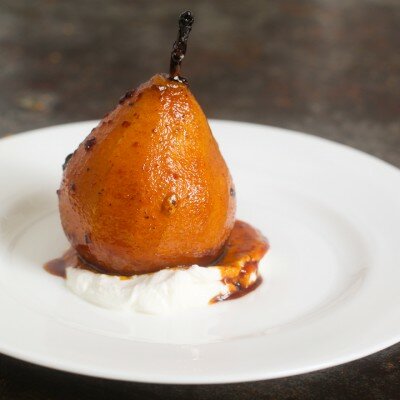 Pear cookery is the subject of the day. Of course, for such an effort one needs pears, and when one needs pears one is confronted inevitably with the Bosc-Bartlett dilemma. (Okay, there’s Anjou and Comice etc., but let’s be real.) Despite sounding like a physics theorem or a House budget proposal, Bosc-Bartlett is universally familiar. And as I stood before the adjacent towers of Bartletts (green) and Boscs (brown), I was reminded of the Curb Your Enthusiasm episode, which hinges on the Bosc-Bartlett confusion.
To my mind, they’re interchangeable, the only notable difference being shape. I prefer the Bartlett, which is fuller-it reminds me of a bumpy baby’s head-and thus more impressive on the plate. The issue then, is how to cook these similar fruits. Because they hold their shape, pears are ideal for poaching. However, a roasted pear is equally delicious, though a bit more challenging. Roasting fruit is not as easy as it sounds: the goal is a unit of contradictory properties, caramelized on the outside but juicy and tender on the inside.
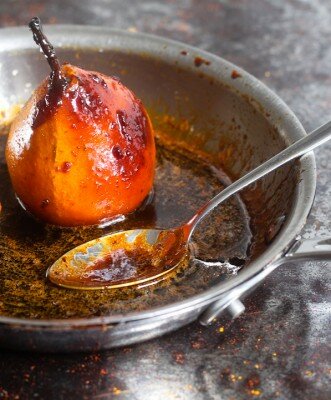
There’s nothing worse than a dried-out chunk of roasted fruit; the fruit world’s equivalent of an overdone piece of salmon. The key is surrounding and basting the fruit with just enough sugary liquid, which will coat the pears as they brown. You should also pack them together in the dish; the juices seep out and mingle nicely.
It all depends on what you’re looking for: a hot pear, soft and slightly golden out of the oven, or a darker, almost candied fruit sitting in a sticky sauce. Straight from the Chanterelle dessert cookbook, this recipe results in the latter, but you can’t go wrong with either version, especially accompanied by a dollop of full-fat strained yogurt. About these pears there’s no confusion.
Honey Roasted Pears (adapted from Chanterelle dessert cookbook by Kate Zuckerman)
Yield: 10 pears
1 lemon
10 pears
2 tablespoons butter
¾ cup sugar
¾ cup honey
strained Greek yogurt
- Preheat oven to 425.
- Peel zest into a few strips. Peel pears and slice section 1/3 inch off the bottom so they can stand up.
- Place in pan tightly along with the sugar, honey, and butter. (They mix by themselves in the oven.)
- Bake pears for 30 minutes then turn over onto one side and bake 20 minutes. Turn onto the other side and bake 20 minutes more.
- Stand the pears up, baste with juices and bake 15 minutes. Repeat, basting every 15 minutes for another 45 minutes. You may need to roast further.
- Serve with the caramel sauce and yogurt. Removing the core from the bottom with a little knife is optional (for me at least).
Yeast Donuts

Sunday began in cold and ended in cold. Soccer with the kid on the roof of Pier 40; bleak and gray, haunted by the storm, the place feeling even more rickety and about to drift off its moorings into the sea than it usually does. Even the vending machines, source of the traditional post-soccer breakfast of champions Kit-Kat, were beaten down by Sandy, wiring drenched, unable to dispense candy.
Step two-the warm part of the day-was a long postponed plan to sell donuts and hot cider on Broadway. It was a new effort, but with the Joy of Cooking as our guide, we already had a few batches of dough proofing in the fridge, ready to be rolled, cut, fried, and sugared.
The donuts tasted like real honest to goodness awesome donuts. You definitely need to pull out the candy thermometer and gauge the oil temperature, or they’ll brown too quickly before cooking on the inside. However, no one ever suffered at the hands of an underdone (or overdone) fresh donut.
And back to the cold. Downstairs on Broadway, where we tried to sell our piles of donuts with a cup of hot cider. We learned a few lessons: kid-run food stands are designed for the suburbs, and it’s best not to sell pastry and cider next door to a Starbucks. Still, despite the kid eating half the inventory, we made a few sales, enough to feel good about the effort, before heading upstairs and out of the cold.
(NOTE: get a thermometer if you don’t have-keeping the oil at 325-350 is important and the therm. will tell you when to adjust the heat. Adding donuts reduces the temp., which will soon rise.)
Yeast Donuts (straight from The Joy of Cooking)
Makes about 20
1 cup warm water
2 envelopes instant yeast
4 ½ cups flour
2/3 cup sugar
2/3 cup butter, softened
3 eggs
1 teaspoon salt
oil for frying
2 cups cinnamon sugar (about 2 cups sugar tossed with a tablespoon or so cinnamon)
- In standing mixer bowl (you can use a standard bowl), whisk yeast and water, cover and let stand 10 minutes.
- Whisk in 1 cup of the flour, cover with plastic and let stand at room temp till bubbly-about 30 minutes.
- Whisk in the remaining ingredients except flour (standing mixer or elbow grease). Using the paddle attachment on standing mixer, beat in the remaining flour. Cover with plastic and let rise for 2 hours.
- Punch down the dough, remove from bowl, wrap in plastic, insert into a large ziplock bag, and refrigerate for at least 3 hours or up to 16 hours.
- When ready, roll dough on a lightly floured surface to about 1/3 inch thick. Cut the donuts with a 3 ½ inch cookie cutter and cut out holes with a smaller (1 inch or so) cutter. Roll scraps and repeat. Rest the donuts for at least an hour until they rise.
- Meanwhile, using a candy thermometer, heat several inches of oil in a large pot over medium-high heat to 350.
- Set up a frying station: line one baking sheet with paper towels to drain oil and set next to a second baking sheet spread with the cinnamon sugar.
- Carefully slide the donuts (about 6 at a time) into the oil without crowding. Using a fork or, ideally, a pair of chopsticks, cook until golden brown on each side – about 1 ½ minutes each. Remove, drain on towels, shift to second tray and roll in sugar. Eat.
Peach Turnovers

The other day, picking up our kid from nursery school, I was smacked by the smell of burning pancakes and boiled spinach. It was nothing new: nursery schools, like my late grandpa’s apartment, smell like a weird mixture of mismatched foods prepared by, well, children or, um, barely sighted old people. Pancakes, spinach turnovers, gluten-free carrot cake, nut-free granola, applesauce, smores, lentil-stuffed peppers.
Cooking is said to help kids learn. At home, we use it more as a way to keep him out of trouble. And so we attacked peach turnovers; a delicious dish but in retrospect not the most kid-friendly project.
This version, taken from a bunch of websites, is a bit more involved, in that the dough, a quick puff pastry, requires a series of folding and resting to work in the vast quantity of butter. Unfortunately, the longer a child is exposed to an ingredient, the more damage he can do, which is why I lost half the dough, stolen while my back was turned.
The not so happy ending was discovering a giant ball of raw puff pastry under my bed. The happy ending was a crispy, flaky turnover filled with hot fruit. And the warm smell of said pastry filling my senses. Until next day’s school pickup.
(Note: For a cleaner filling, we peeled the nectarines. The original recipe used apples, but it’s summer.)
Flaky Peach (or nectarine) Turnovers (via a blinding web of internet sources)
Makes about 20
For the dough: 1 cup sour cream
1/2 cup sugar
4 cups all-purpose flour
1 teaspoon salt
3 sticks (12 ounces) cold unsalted butter, cut into small
pieces
For the filling:
1 tablespoon all-purpose flour
1/2 cup sugar
1/4 teaspoon ground cinnamon
6 nectarines peeled, cored, and cut into small chunks
3 tablespoons cold, unsalted butter, cut into small bits
1 large egg, beaten with 1 teaspoon water, for egg wash
sugar, for dusting
To make the dough:
- Stir the sour cream and sugar together; set aside.
- Whisk the four and salt together in a large bowl, then toss the butter bits over the flour. Working with a pastry blender, two knives or your fingers, cut the butter into the ingredients until the mixture resembles coarse meal. Don’t worry about being thorough – it’s better to have an uneven mix than an overworked dough. Switch to a fork and, using a lifting and tossing motion, gently stir in the sour cream. The dough will be very soft.
- Divide the dough in half. Put each half in a piece of plastic wrap and use the plastic to shape each piece into a rectangle (don’t worry about size or precision). Wrap the dough and refrigerate it for at least 1 hour, or for up to 2 days.
- Remove one piece of dough from the fridge and roll it into a rectangle about 9 x 18 inches. The dough is easiest to work with if you roll it between sheets of wax paper or plastic wrap – if you want to roll it traditionally, make sure to flour the rolling surface. Fold the dough in thirds, like a business letter, wrap it and refrigerate it. Repeat with the second piece of dough, and refrigerate the dough for at least 2 hours or up to 1 day.
To make the filling:
1. Whisk the flour, sugar, and cinnamon together in a large bowl. Add the nectarines and toss to coat.
2.Getting ready to bake:
3. Position the racks to divide the oven into thirds, and preheat the oven to 375 degrees F. Line two baking sheets with parchment or silicon mats.
4. Roll out one piece of dough to a thickness of about 1/8 inch, and cut out 4 1/2 inch rounds with a large cutter or the edge of a tartlet pan. Repeat with the second piece of dough. If you’d like, you can gather the scraps together, chill them, and make additional turnovers. (The turnovers made from scraps will taste good, but they won’t be as pretty and light as the first rounders.) You’ll get 7 or 8 rounds from each piece of dough.
5. Place 1 to 2 tablespoons nectarines in the center of each round and dot with the butter. Moisten the edges of each round with a little water and fold the turnovers in half, sealing the edges by pressing them together with the tines of a for. Use the fork to poke steam holes in each turnover, and transfer the turnovers to the baking sheets. (At this point, the turnovers can be frozen; wrap them airtight when they are firm and store them for up to 2 months. Bake them without defrosting, adding a few minutes to their time in the oven)
6. Brush the tops of the turnovers with a little of the egg wash and sprinkle each one with a pinch of sugar. Bake for about 20 minutes, rotating the baking sheets from top to bottom and front to back after 10 minutes. When done, the turnovers will be puffed, firm to the touch, and golden. Gently transfer them to racks and cool to room temperature.
Peach (or Nectarine) Ice Cream

Some cookbooks serve up that extra step, requiring you to use your greasy fingers and flip to the back of the book for a component recipe to the dish in front of you. As I always say, taste is most important, so if greasing up a few pages makes the thing more delicious, I don’t mind.
With master recipes such as ice cream, or those which only slightly vary, you don’t usually have to pull out that extra pan or shuffle through the book. Fruit ice creams, however, invariably benefit from a little side action, or that step, which, as Albert Roux would say, “can only do it a lot of good”.
Mixing fruit into anything is a tad risky; unless it’s high season, you’re at nature’s mercy. Take a blueberry pancake, which I loathe for those soggy, tasteless pockets getting between me and my buttery syrup. If you must toss blueberries in your pancake, you have to sweeten them-take that extra step.
Even though we’re in peak peach/nectarine season, you can’t just fold them into the base and expect a bold, peachy ice cream. They too need a little sugar bath. In the case of ice cream, however, adding syrupy, mascerated fruit, throws off the formula, which, if you can deal with it, makes for a nice, slightly lighter, slightly icier dessert.
We took this recipe straight from www.bunkycooks.com (who took it from http://someonekitchen.blogspot.com/, who took it from Gourmet but who’s counting) I’m not usually a fan of direct recipe (and even text) theft, especially after the whole Jonah Lehrer thing, but in this case, the photos looked great, the recipe looked great, and the ice cream, most importantly, tasted great. Dunking the peaches in a bowl with sugar for 8 hours: an extra step, sure, but worth it.
Oh yeah. We used nectarines.
Peach Ice Cream
Yield: Makes approximately 2 quarts
2 pounds ripe peaches/nectarines
2 teaspoon fresh lemon juice
1 cup plus 2 tablespoons sugar, divided
1 1/2 tablespoons cornstarch
1 3/4 cups heavy cream
1 3/4 cups whole milk
4 large egg yolks
1/2 teaspoon pure vanilla extract
1/4 teaspoon pure almond extract
1. Cut an X in bottom of each peach, then blanch in boiling water 15 seconds. Transfer with a slotted spoon to an ice bath to stop cooking. Peel peaches and cut into 1/2-inch pieces. Toss with lemon juice and 3/4 cup plus 2 Tbsp sugar in a large bowl. Let macerate, covered and chilled, at least 8 hours.
2. Whisk together cornstarch, 1/4 tsp salt, and remaining 1/4 cup sugar in a heavy medium saucepan. Add cream and milk and bring to a boil over medium heat, whisking constantly. Add to yolks in a slow stream, whisking constantly, to temper and pour mixture back into saucepan.
3. Cook, stirring with a wooden spoon, just until custard coats back of spoon and registers 170°F on an instant-read thermometer, 1 to 2 minutes (mixture will be thick). Strain through a fine-mesh sieve into a metal bowl and stir in extracts. Chill custard, its surface covered with parchment paper (to prevent a skin from forming), until cold, at least 4 hours.
4. Transfer 2 cups peaches with slotted spoon to a bowl.
5. Purée remaining peaches and liquid in a blender until smooth. Add purée to custard and freeze in ice cream maker (following your manufacturer’s directions), then transfer to a bowl and stir in reserved peaches.
6. Transfer to an airtight container and put in freezer to harden, about 2 hours. *Be sure to seal the top of the ice cream mixture tightly with a piece of plastic wrap pressed firmly against the ice cream to prevent ice crystals from forming. Top with the lid’s airtight container until ready to use.
Gourmet
June 2008
Giant Meringues

On Spring Street, just across from what we fondly term the dirty playground (where the homeless outnumber the kids), there’s a set of odd neighboring businesses. One sells exclusively rice pudding, the other low fat frozen yogurt, and on hot weekends, the lines are long at both places.
You’d think the pudding eater and the yogurt eater would, let’s say, present differently. I suppose the academic nutritionist could sit (in the dirty playground) clipboard in hand and eye the girth of respective customers, but in our years of living here, as a casual observer, I’ve never seen a difference.

I do, however, notice a difference between (given a general awareness of healthy eating habits) faux foodies and real foodies. Actually, “foodie”, as far as I can tell, merely means you like to eat out, while “real foodie” denotes a person who likes to consume actual food comprised of ingredients not birthed in a lab or produced via atomic collider. Like cake from flour or lemonade from lemons.
For the faux foodie, the holy grail is the zero calorie food that doesn’t quite taste like crap: Willy Wonka in a lab coat and a hair net, glowing oompah loompahs, walls papered with ultra-light candy, and rivers of “chocolate product”.
Let’s take the common meringue. A meringue is a frothy mix of egg whites and sugar. Bad for the 4-year-old in his Spidey Man jammies at bedtime. Good for everyone as a treat (save for diabetics). Zero fat, high sugar. “Faux meringue” has zero fat, weird sweeteners, a library of stuff in tiny print, and glue. It also tastes like moon food, dissolving on the tongue instantly, like a raindrop in the ocean.
To concoct a fake meringue is to concoct fake zero fat food. Fairly extreme. I’m hardly on a mission to convert the faux foodie, but at the very least, for chrissakes, eat a real meringue. It’s easy to make, sweet yet bland enough not to be addictive. And they taste even better on a bench in your nearest dirty playground.
Meringues
Makes enough for 8
1 cup egg whites (about 8 eggs)
1 cup granulated sugar
2 cups confectioner’s sugar, sifted
1 teaspoon vanilla extract
- Preheat oven to 200.
- Line two baking sheets with buttered parchment paper, butter side up.
- In a mixer, beat egg whites to soft peaks, add the granulated sugar, beating to stiff peaks. Fold in the confectioner’s sugar and vanilla.
- Spoon the mixture into a piping bag or large ziplock bag and pipe large meringues, about 3 inches high and 4 inches wide. Space them an inch apart. You can also drop free form giant spoonfuls.
- Place in oven and back 1 ½ to 2 hours with the oven slightly ajar until crispy outside and soft within. Cool and serve with all kinds of stuff like jam, ice cream, etc.
Nectarines and Chocolate

Every entertainer has to occupy a type-the hero, the villain, the nerd, based on little more than appearance. If you look like a dork, you won’t play a Scot leading his troops into battle. Conversely, a stocky, decent-looking guy won’t be the kid who gets stuffed in a locker.
Follow the type or don’t work. In comedy it’s called a shtick: the foul-mouthed wise ass (Rickles) or the funny neighbor (Seinfeld). Food people follow suit, from Bourdain’s irreverent rebel to Paula Deen’s bosomy southern mama. Mark Bittman is a curious case, however. His work used to be obsessively purposeful, full of a missionary zeal to get the fearful to fire up their stoves.
That worthy goal has become, yes, a shtick, one which tortures me every Sunday as I flip through the NYT magazine on the way to the crossword puzzle. Here are 20 possible salads featuring kale; 8 variations on the lemon dessert. It’s like someone who gives the tourist twelve ways to get to get to Grand Central, leaving the guy stranded on the corner, paralyzed.
As I see it, Bittman’s method helps two types: the hoarder and the attention deficit sufferer. The former has a home bursting with ingredients while the latter can’t focus on just one dish. Or, in the case of, say fifteen summer salad options, the chronic picnicker.
Simplicity is a bedrock cooking philosophy; it’ll win every time. One great beet salad recipe is better than a stack of beet salad variations. Here’s a tasty and uber simple three-item summer dessert: nectarines and chopped chocolate with a pinch of kosher salt. Simple and shtick-free.
Nectarines and Chocolate
Serves 4
4 superb nectarines, quartered, sliced, chopped, whatever you feel like
2 oz. dark chocolate
pinch kosher salt
1. Place fruit in bowl, shower with salt and chocolate. Serve.
A Cherry Menu


Come summer, New York becomes a city out of a science fiction novel, its citizens shut in for fear of the gaseous atmospheric conditions outside. Halfway down the block, you feel something strange: the shirt you put on this morning becomes a wet, sticky, second skin, and the head you woke up with begins to sweat like the glass of a cold cocktail left out in the sun, although these droplets are hot and salty and sting the eyes. And so we chain ourselves to our air conditioners.
New York is denser than a ball of rubber bands. The only available space is the sky; people are packed atop and wound around one another, and that’s only half the story. As involved is the world below the pavement: pipes, subways, cords, wires, and so on. The result is a world wrapped around itself, trapped in its population and structures, totally unfit for summer heat, which is why I seem to take several showers a day.
Scattered within this map are particularly unpleasant, flaring hot spots. Such as Chinatown. Chinatown in the summer is a throwback, a piece of the city untouched by urban planners and whoever sits around thinking of mixed spaces and bike lanes. The only thing mixed here is the air, a soupy whiff of hot kitchens, sweating fish, and sweating people. However, Chinatown is the cherry zone: street vendors sell bags of cherries at prices so cheap I suspect something nefarious. But as long as I get my cherries…
Cherries may be about sunshine and middle America and pie and cute towns, but to me, cherries are about Chinatown in the summer, and threading my way on my bike, through the streets and the humidity to grab my bags of cherries. This is a truncated menu using cherries; raise a glass to Chinatown and New York in the summer.
Mustard Crusted Salmon w/ Cherries
Serves 4
4 salmon fillets, 6 oz each, skinless
2 tablespoons Dijon mustard
2 tablespoons fresh bread crumbs
1 shallot, minced
2 cups red wine
¼ cup balsamic vinegar
2 cups cherries, halved
2 tablespoons cream
4 tablespoons unsalted butter
chopped parsley
salt and pepper
- Season each fillet lightly with salt and pepper, spread one side of each fillet with a thin coating of mustard and sprinkle over bread crumbs. Reserve.
- For the sauce, in a small saucepan, sauté shallots in 1 tablespoon of the butter until soft, add the balsamic vinegar, wine, and half the cherries, mashing them as they soften, and reduce to a few tablespoons, then whisk in the cream and butter. Strain through a fine mesh strainer, stir in remaining cherries, season, and reserve.
- Heat a broiler and broil the fish, coated side up, until medium rare, about 6 minutes.
- Heat sauce, stir in some parsley, spoon some of the sauce including the cherries, on a plate, and top with the salmon.
Cherry Clafoutis
Makes 1 tart
1 tablespoon unsalted butter
3 tablespoon flour
¼ c sugar
2 egg yolks
1 cup heavy cream
3 tablespoons kirsch
1 ½ pounds cherries, pitted
pinch salt
4 eggs
1 cup milk
1 vanilla bean, split and scraped
confectioners’ sugar, for dusting
- Preheat oven to 375. Butter a 10-inch clafoutis dish and fill with cherries. Set aside.
- Sift flour and salt together into a bowl. Add sugar. Whisk in eggs, egg yolks, milk, and cream. Add vanilla and kirsch; whisk to combine.
- Strain batter over the cherries, bake until puffed and browned, about 45 minutes. Let cool until warm, dust with confectioners’ sugar and serve.
Cherries and Cream
Serves 6-8
2 pounds cherries, pitted and halved
2 cups heavy cream, whipped to stiff peaks
1. Place cherries and cream in separate bowls.
2. Eat.
Apricot Beignets

Choux pastry, the stuff of which éclairs are composed, is the result of neat kitchen chemistry. I have no idea how it works; all I know is that, one minute you’re boiling butter and milk, the next minute you have a tray of hot, puffy things with hollow insides, made for stuffing, which is how you get an éclair.
But when, really, was the last time you had an éclair? The éclair is a misuse of the entire choux concept; they should be eaten hot or not at all. That means frying them as beignets, as they do at Annissa (the tiny, crispy gems are also filled with warm butterscotch), or baking and filling them with ice cream, as in profiteroles.

This recipe comes from a book that’s been sitting on our coffee table for a few years, French Country Kitchens. Not exactly the kind of thing that calls out to you at a bookstore, so I assume it was a gift. It’s filled with pictures of French home kitchens, each quainter than the next: old copper pans, antique stoves, baby blue and white tiling, windows facing the herb garden in the backyard. Still, there are some attractive recipes for vegetable gratins, roasts, and apple tarts; the kinds of thing you’d expect to find in the French countryside.
You get the sense that here sits a nation of people in their yards eating warm beignets. True or not, this is a choux recipe notable in that you boil the dough and then roll them in fried breadcrumbs. It’s a romantic recipe for a romantic vision, true to the spirit of choux pastry, so often mangled into an éclair.
(NOTE: we used dried apricots. You can soak them a bit to soften. We also used a healthy pinch of sugar as a substitute for sugar cubes. You probably don’t have sugar cubes lying around, and this works fine. Just pry open the apricots and drop in a good pinch of sugar.)
Apricot Beignets (adapted from French Country Kitchens)
Serves 4
For the pastry:
½ cup milk
2 tablespoons unsalted butter, cut in small bits
salt
2/3 cup flour
1 egg
For the dumplings:
12 fresh apricots (see NOTE)
12 cubes sugar (see NOTE)
6 tablespoons unsalted butter
¾ cup breadcrumbs
3 tablespoons confectioner’s sugar
1. For the Pastry: In a medium saucepan over medium high heat, combine milk, butter, and a pinch of salt. Boil, lower heat, add flour and stir to combine. Remove from heat and add egg. Stir vigorously until a ball has formed. Cool off the heat to room temp.
For the Dumplings:
- Bring a large pot of water to a boil.
- Meanwhile, roll the dough into a log about 2 inches thick. Using a bench cutter, cut into 10 or so pieces. Roll or press each into a circle about 1 ½ inches in diameter.
- Stuff an apricot with sugar, place in the center of a round and fold to enclose the fruit completely. Repeat.
- Boil the dumplings for about 15 minutes. Meanwhile, melt the butter in a medium pan and fry the breadcrumbs until golden. Remove to a plate.
- Use a slotted spoon to remove dumplings, roll in the crumbs and dust with confectioner’s sugar.
Lemon Curd and Whipped Cream Open Sandwiches

Inspiration comes in the strangest of places. There’s the cliché of the novelist who scrawls plot lines on the back of cocktail coasters. The same applies to food, though I find that dishes need a little nudging from surrounding smells, tastes, and sounds.
Scrolling through Tastespotting the other day I saw a beautiful photo of lemon curd: bright yellow, in a few ball jars, a tiny drip rolling down a side. Later that evening, I had a cup of the stuff chilling in the fridge.
Like tahini (another simple sauce), lemon curd is powerfully inspiring; a nearly blank slate for a bunch of flavors. In this case, whipped cream came to mind. A happy marriage, to be sure, though a mighty soft one, and something you might find served in a plastic cup at a nursing home before bedtime.
I desperately needed a biscuit or some kind of crunch. Maybe a brittle? But I wasn’t in the mood to bake, and, like I said, inspiration comes in the strangest of places. Such as the Met Market on Prince Street, a mid-level supermarket good for (relatively) inexpensive beans, milk, and for my curd, cream. Passing the bread aisle, headed for the peanut butter, I paused before the stacks of Pepperidge Farm white.
Lemon Curd, whipped cream on toast. Of course. Easy. Back home, standing before two bowls, one with lemon curd, the other whipped cream, and a stack of toast, I started to make sandwiches. Unfortunately, when you slice a whipped cream sandwich, the whipped cream tends to pour out the sides. Foiled.
Fortunately, we have striped wallpaper, which is how I decided to make the thing into an open sandwich and pipe out alternating lines of lemon curd and whipped cream. Success by way of Tastespotting, Met Market, and wallpaper. The culinary equivalent of the back of a cocktail coaster.
Lemon Curd w/ Whipped Cream Open Sandwich (from Gourmet via http://cravingchronicles.com/)
Makes about 8 sandwiches
1/2 cup granulated sugar
zest of 2 lemons
1/2 cup lemon juice (about 3-4 large lemons)
2 large eggs
4 tablespoons unsalted butter, cut into tablespoon-sized pieces
1 cup heavy cream whipped to stiff peaks
white bread, crusts removed
confectioner’s sugar
1. Add all ingredients except butter to a saucepan over Low heat. Whisk to combine. Add butter. Continue whisking gently but constantly, heating slowly, until curd thickens and reaches 160°F on an instant read thermometer. Remove from heat.
2. For the smoothest curd, pour through a fine mesh strainer. Transfer to a storage container. Cover and refrigerate overnight before use. Curd keeps up to 1 week in the fridge.
3. To complete the sandwich: toast the bread on both sides. Place the curd and cream in separate ziplock bags, cut a small hole in the corner and pipe alternating stripes of curd and whipped cream. Dust with confectioner’s sugar. Alternatively, spread toast with lemon curd and top with whipped cream.
4. Chill in freezer for about an hour if desired.
Thai Tapioca Dessert w/ Pineapple and Black Sesame Brittle

I was making cherry jello the other day. Not because I’m 85 or work in a school cafeteria (“caf” in Brit-speak, fyi), but the only other legitimate reason for making jello: kids. Even though jello is a “just add water” “food” and a side panel list of bogus ingredients longer than Shaq’s wingspan, I didn’t feel guilty. He eats pretty well, and a cup of processed hell can only do some good.
So when it was set, we pulled out the ruby-red stuff from the fridge and, with two spoons-one large, one small-had at it. Confusing the hell out of a four-year-old can be fun, and so, spoon in hand, I became a jello sommelier.
The taste was “fruity yet fake”; “summery with a hint of paint thinner”; “lush yet leathery”. But with jello flavor is secondary; it’s all about texture. Kids love the stuff because they have weird palates and like all kinds of odd textures, one of which happens to be slippery, amorphous and, well, “jello-like”.
Tapioca pudding is another “caf” and nursing home staple. It’s mushy and sweet, but tapioca departs from jello in its richness. Whereas jello is coagulated liquid, tapioca pudding is essentially a custard made usually with eggs and milk. As such, it’s quite delicious and, to be fair, a food for all ages.

However, Vietnamese tapioca is a celebration of tapioca itself, much like jello is a fiesta of gelatin. As with jello (whipped cream), the rich topping (coconut cream) is optional. Ungarnished, it’s mildly sweet, warm, and very gelatinous. In other words, a whimsical little bowl. Which is an adult way of saying it’s good stuff fit for any kid with a spoon.
(NOTE: Feels like I’m repeating myself these days, but it’s inevitable when writing about Thai/Viet food. Go online for this tapioca, the other stuff won’t work, I’m pretty sure. Again, we use Bankgokcentergrocery.com)
Vietnamese Tapioca Pudding w/ Pineapple, Frozen Banana, and Black Sesame Brittle
Serves 6
3 ½ cups water
1 cup Asian tapioca pearls (see NOTE)
¼ teaspoon salt
½ cup sugar
2 cups pineapple diced ¼ inch
½ cup coconut cream on the side
1 banana, frozen, chopped about ¼ inch pieces
Black Sesame Brittle
- Boil the water in a medium pot, stir in the salt and tapioca, lower the heat slightly and cook 15-20 minutes until cooked and soft.
- Stir in the sugar until dissolved.
- Divide among the bowls and serve warm with the pineapple, frozen banana, and coconut cream on the side or spooned on top.
Black Sesame Brittle
½ cup sugar
¼ cup water
¼ cup black sesame seeds
1. Have ready a tray with a silpat or parchment sprayed with nonstick spray. Combine sugar and water in a small pan over medium high heat and boil, stirring a bit until the sugar to color lightly then stir in the seeds and pour onto the prepared tray in as thin a pool as possible. Let cool and break into small shards.