Sandwiches
Homemade Sausage and Peppers

Thomas Keller says he keeps two things on the stove at all times: salt and acid, acid being citrus, or more likely, some kind of vinegar. Rather than, say, pepper, which adds a unique flavor, salt and vinegar act as a welcome air current to bird, carrying and intensifying existing flavor. A pinch of cumin makes a dish tastes a bit like, well, cumin. But a splash of balsamic can balance, or round out the picture, cutting through the fattiness of a steak or creamy sauce.
In addition to vinegar, Keller also savours publishing the occasional punishing recipe. Like a tennis serve, the mechanics may seem simple, but take a long time to master. Such is the case with his famous salmon tartare cones, which took me about a year to conquer. (A tip: when the butter starts bubbling, it’s ready to flip and mold.)
A perfect sausage is a like a speedy, accurate, tennis serve, requiring more than a little practice. We make our own fresh sausages around here, thanks to Pino the butcher, the Meat Hook’s cheap casings, and a streak of ocd. Usually we encounter the occasional split casing, or, more typical, a puff of meat popping out from both ends while in the frying pan.

Only yesterday did we produce flawless links. Way back, we learned about pricking out air holes, but the final key, it turns out, is to spin the ends vigorously while forming fresh links. That ensures a nice tight tip guaranteed not to burst.
But while it’s nice to master tricky recipes, it’s even nicer to broaden your touch, your food aptitude. Which is where the vinegar comes in. We stole this sausage dish from Andrew Feinberg via the doorstop-sized CoCo cookbook, down to the sautéed peppers served alongside the fried links. Sausage and peppers is pretty common, but, due to a tiny splash of balsamic, these peppers were perfect. The vinegar lightened the pork and brightened the whole plate. Keller (and, of course, Feinberg, would approve.
If there’s a lesson here, it’s not to be discouraged by tricky recipes. Having salt and vinegar within arms reach is half the battle.
(NOTE: get a kitchen scale. Curing salt optional, but they retain freshness and color. These freeze well. Also, when you grind, run through large, then fine die. Also (#2) make sure the butcher (if you’re making links) gives you casings packed in salt-they last a year. If you already possess a Kitchen Aid and have a bit of time, don’t be a schmoe: get the grinder/stuffer accessories. We added a bunch of directions on the processing-the book is sort of for the already-chef.)
Homemade Sausage and Peppers (From Coco and adapted from Andrew Feinberg)
Makes about 20 links (or a bunch of patties)
For the sausage:
Hog casings
4 ½ pounds fatty pork butt
½ pound pork belly
1/3 pound chopped parmesan
4 cloves chopped garlic
2 tablespoons salt
black pepper
5.6g curing salt
1. clean casings (see NOTE). Soak in a bowl of running water and run water through them several times. Make sure not to tangle.
2. Grind ingredients (see NOTE). Stuff casings – this probably takes 2 people – one to feed, the other to hold.
3. Prick all over with a sharp needle or some such device to pop air bubbles. Twist into links-turn several times. Freeze or use as desired.
For the peppers:
2 red bell peppers, cleaned, in ½ inch dice.
Olive oil
2 tablespoons balsamic vinegar
Salt and pepper
To finish:
1. Warm about 2 tablespoons olive oil in a large pan over medium high heat. Add peppers and let fry, untouched until lightly charred, then toss and cook till soft. Add balsamic vinegar and toss until peppers are coated, season and remove.
To finish:
- Preheat oven to 350.
- Fry 4 or 5 sausages in a large pan (don’t overcrowd or they’ll steam), rolling gently to brown all sides. Remove to oven for a few minutes. Serve with peppers.
Brillat-Savarin Grilled Cheese w/ Caramelized Onions

I first met Brillat-Savarin cheese by accident, sort of. By sort of, I mean I was in a cheese shop, looking for cheese, specifically one that’s spreadable, and not cheese whiz, a spreadable i.e. super fatty, luscious cheese. I like brie and its cousins, especially on a panini with paper-thin prosciutto on black bread with sesame seeds and a drizzle of truffle oil on the streets of Lugano on the Swiss-Italian border.
But I was in our neighborhood, on a busy Soho weekend when the tourists descend like flies and dump their trash and maps all over the streets. Maybe a switch from brie would do me some good, and so I ducked into Dean & DeLuca, my most reviled store, to peruse the ultra-fatty cheese section. Among the creamy white wheels and wedges I picked the Brillat, a cheese, which would alter my worldview-political, culinary, emotionally, etc.
A massive stack of napkins is to the juiciest burger as a spoon is to a properly left-out Brillat-Savarin: critical tools. The spoon slides through the triple cream like a knife through melted bone marrow. However, unlike your standard rich cheese, Brillat isn’t a mouthful of fat; it carries with it a grassy barnyard, in other words, a little backbone, which is impressive for such an unctuous situation.

Now it’s a staple indulgence, and not just to eat as is, but in cooking, for instance, a grilled cheese. When you think grilled cheese you think gruyere or raclette or any kind of good melting cheese. But Brillat makes a delicious, if slightly trickier product; tricky because it doesn’t hold its shape. Rather, when warmed, it becomes a pool of goaty cream, which, as you might suspect, can result in soggy bread.
So you need a protective layer (in this case caramelized onions), a watchful eye, and above all, a stack of napkins. As I said, Brillat is the burger of cheese: you need a spoon and, I guess, a bunch of napkins.
(NOTE: Caramelized onions should be a fridge staple: slice a few large onions thinly and cook slowly in butter until deeply gold (does that mean amber? Not sure.) For this recipe, use them at room temp.)
Grilled Cheese w/ Brillat-Savarin and Golden Onions
Makes one sandwich, rich enough for 2
2 large slices country bread, ½ inch thick
3 tablespoons caramelized onions, room temp (see NOTE)
2 ounces Brillat-Savarin cheese, room temp
1 teaspoon ground coriander
1 tablespoon unsalted butter
- Scatter onions over one slice and drop pieces of the cheese over the onions. Cover with second slice. Sprinkle over the spice.
- Melt butter in a medium pan and brown, about 3 minutes per side. Done.
Paneer, Homestyle

It’s tough: you go to a good pizza place, even a great one (like Pulino’s), return home determined to replicate your funghi (mushrooms to you and me) pie, and fail miserably. And then of course, you hit the internet and a week later, after a web-induced pizza buying frenzy, the ups guy drops a sack of bricks and assorted tiles on your porch. Or elevator in this case.
So you stuff the oven full of bricks and heat it to 550, roll out your yeasty, lovely homemade dough, spread thin layer of toppings, slide it onto the burning hot stones. And pull out a halfway decent pizza; edible, even tasty but a pale imitation.
The fact is that, in some cases, there’s an excuse for one’s inability to recreate a magnificent professional culinary product, and this happens to be one of those cases. On the way to Pulino’s characteristically McNallyish facilities you pass by the open pizza area and are smacked by a wall of heat straight out of a Vietnam flick. Their pizza peels flying, the cooks whip pizzas in and out at a dizzying rate. Which means, naturally, that they cook instantly due to said blistering heat.

To attempt a home recreation of this scene would be extraordinarily dangerous, and thus we’re left with the perplexing issue of the perfect home pizza. Don’t let them fool you: it’s impossible.
If that’s impossible, imagine my frustration over tandoori chicken. A tandoor is a sort of in-ground, vertical pizza oven, which promotes the ideal environment for lots of Indian stuff, like chicken, lamb, vegetables, breads, etc. The surrounding heat donates a smoky char you’d never get via any other grilling or roasting method.
The greatest item to cook in a tandoor, however, is paneer, Indian cheese. The stuff is marinated in a bunch of spices and yogurt (I think-at least that’s what the Tamarind menu claims), cubed, threaded onto the skewer, and given that magical treatment. The result is a scrumptious, semi-soft bite, dry and semi-charred, coated with a bit of blackened spice and herbs.
The dish is good-great-enough to warrant some drastic home measures, but alas, reality sets in, and you have to settle for second best. Broiling was the only option, as the product must be dry with that grilled char. As with the Pulino’s pizza oven, the tandoor heat probably cooks the paneer in seconds. Not so at home, where, by the time your paneer is cooked, the spices are burned to hell.
And so I used the method preferred with many Indian dishes: fry the spices and dump them over the cooked item. Aside from the paneer being rock solid, it tasted okay. That’s when I gave in and read where some guy softened his paneer by soaking it in boiling water prior to cooking. Lo and behold it worked. The result was a (relatively) tender, browned plate of paneer livened up by a handful of fried curry leaves and spices.
While it wasn’t as good as the Tamarind version, at least my paneer was plenty tasty. Sometimes second best isn’t too bad.
Broiled, Spiced Paneer
Serves 2 as part of an Indian meal
8oz paneer, in ¾ inch cubes
¼ cup olive or canola oil
1 tablespoon cumin seeds
1 tablespoon urad dal
1 tablespoon mustard seeds
2 teaspoons crushed chili peppers
10 curry leaves
chopped cilantro
salt
- Add the paneer to a medium bowl and cover with boiling water. Let sit at least an hour.
- Drain and dry paneer, place on a rack over a tray and broil for about 1 minute, until golden. It should be heated through. Place on a platter.
- Heat the oil in a small pan over medium high. When hot, add the spices except the curry leaves, chili, and salt. When the mustard seeds pop and the dal darkens, add the chili pepper and curry leaves, fry about 10 seconds and pour over the paneer. Season with salt, scatter over the cilantro and serve.
Corned Beef Sandwich the Right Way
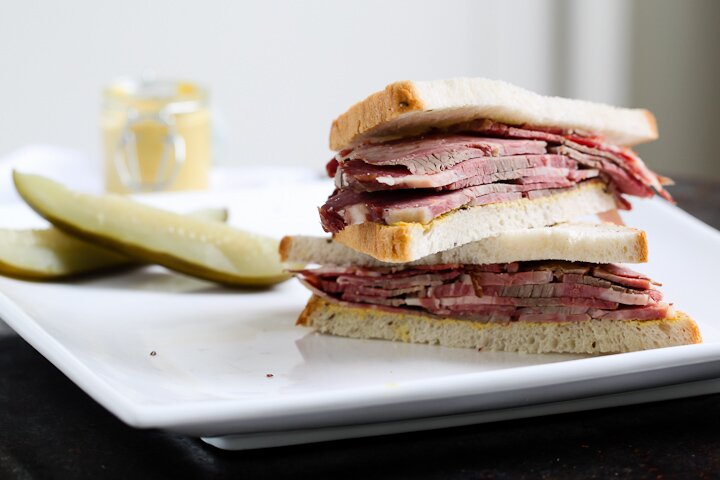
There are several hurdles for the novice dry sausage maker: preservatives, patience, and precision. Fermented, dry sausages (salamis, sopppressata, etc.) take a long time, and, more to the point, must be hung in enclosed areas varying in temperature and humidity. It’s like trying to perfect a golf swing inside a tiny room. And so we made corned beef.
Homemade corned beef is simple and satisfying in the manner of any successful project: brine and simmer a brisket. The sole sticking point being the use of aforementioned preservatives, which are optional anyway, since grey corned beef is as tasty as pink corned beef. But a few tablespoons of pink salt profoundly boost one’s pride.
Any respectable corned beef lover knows that it belongs in one place: between two slices of good rye bread. To fry it up in a pan as hash or serve hot in a stew is a betrayal of all that’s pure and right in the world. Back to the sandwich, for once I have no opinion, as both are great: 1.) mustard (cole slaw optional) 2.) as a Reuben-warm, under a blanket of melted Swiss, sauerkraut and a smear of Russian dressing.
I tend to order (in this case, serve at home) corned beef with mustard because it’s about ten times lighter. Also, a good Reuben is tough to find. Often it’s transformed into an open sandwich slop of corned beef obscured under a pile of cheese. Katz’s, where you’d expect to find the genuine article, delivers a phone book thick stack of meat between bread soggy from an equally heavy hand with the Russian dressing. It’s a clumsy, careless product.
Which is why it makes sense to corn your own beef (if that’s a verb). You can craft your sandwich according to personal taste. You don’t need an exclusive cut of brisket, but because it’s critical to have good rye, I’d recommend sourcing that first. Or baking, if you know about that stuff. Then you’ve got a truly homemade sandwich.
(NOTE: they use ground ginger, which I loathe.)
Corned Beef Sandwich w/ Mustard (from Ruhlman and Polcyn’s Charcuterie)
Makes a lot of sandwiches
1 gallon water
2 cups salt
½ cup sugar
5 teaspoons pink salt
3 garlic cloves, minced or crushed
4 tablespoons Pickling Spice (see below) (halved-otherwise you’re stuck with a
dusty can of excess pickling spice)
One 5-pound brisket
Deli or Dijon mustard
Good, seeded Rye
1. Combine everything except the brisket and 2 tablespoons of the pickling spice (not the bread or mustard if I really need to say that) in a pot, bring to a simmer, stir to dissolve, cool to room temperature and refrigerate until cold.
2. Place brisket in brine (we used a giant ziplock-two actually) for 4 or 5 days. Remove, rinse under cold water, add to a big pot, cover with a lot of water and the remaining 2 tablespoons of pickling spice. Simmer 3 hours. Remove from heat, let cool in liquid. Lift out and refrigerate. Slice and make a sandwich.
Pickling Spice
1 tablespoon black peppercorns
1 tablespoon mustard seeds
1 tablespoon coriander seeds
1 tablespoon red pepper flakes
1 tablespoon allspice berries
1 tablespoon ground mace
1 cinnamon stick
5 bay leaves
1 tablespoon cloves
1. Mix in a bowl. How’s that?
The Best Sandwich Ever

This one is along the lines of meals I’ll never forget. And not because it was the day our son was born or A.J. Duhe intercepted Kenny O’Brien and wrecked the Jets’ season. Or an elaborate concoction of items assembled in a pan, reduced and strained to sauce consistency. This one was just plain awesome.
It was on our trip to Lugano, Switzerland at a table outside a small but bustling panini joint. They had about 20 panini, all simple, based on prosciutto, turkey, mortadella, and salami. Rather than the standard deli slicer we all know and love (except the guy I worked with who cut off a finger), they use a Berkel hand-cranked slicer, which permits one essentially to shave slices of meat thinner than paper-thin, if that’s possible. Let’s call it tissue-thin.
My sandwich arrived, full of that great prosciutto (did I mention Lugano is in the center of meat-eating country, and the cured stuff is excellent), a few slices of brie, baby arugula, and touch of mustard. Good bread is the key to any sandwich, in this case a fantastic, crusty, black bread with sesames. Each bite was as succulent as the next.
I won’t include a recipe; for this one, you need the right ingredients, and if you happen to have the right ingredients, you don’t need me to tell you what to do with them.
Leftover Steak and Eggs
 I ate my first plate of steak and eggs in college at daybreak after a night of drinking. It was at a Boston IHOP and I remember it was very delicious. It is possible, however, that my standards were slightly compromised, no offense to the IHOP chefs. Tastiness aside, I do recall the extreme thinness of the steak; a chewy, overdone affair, a poorly cooked minute steak. But such a cut is precisely what’s called for: it’s breakfast, not a steak dinner; it would be a waste to use a fancy cut like strip or ribeye.
Perhaps because it’s tattooed on my brain as hangover fare, I haven’t eaten steak and eggs since that morning. But as a family man, I find myself living in a universe of leftovers. Last week I ate split pea soup three times; so far this week it’s been slices of Monday’s roast from my man Pino the Butcher.
Pino, actually, suggested steak and eggs as a good leftover option. A sensible and original notion, I gave it a shot. The problem is that I wasn’t sure how to proceed. My recollection from IHOP was that the dish is hot, and I wasn’t about to reheat my perfectly pink steak. Leftover or not, I don’t like grey steak.
And so I hit on cold steak and hot eggs. Hot and cold on the same plate is done all the time. And, more to the point, the only leftover steak is cold steak. It was very good; better than some half-assed, fried piece of gristle. Some cold slices of a good roast, hot scrambled eggs. Steak and eggs for the mature guy.
Leftover Steak and Eggs
For 1, up to 3 days post roasting
3 pound rib roast, with about a ¼ inch layer of fat
3 eggs
touch of milk
coffee
toasted English muffin
salt and pepper
- Preheat oven to 425. Season heavily all over with salt and pepper. You want a nice crust. Roast on a rack for ½ hour until browned and sizzling then reduce heat to 350 and roast to an internal temp of 130 (for medium rare). This may take another 40 minutes, but check after half hour. Remove and let rest about 15 minutes before carving.
- Over the next 2 or 3 days make sandwiches, eat plain with salt, or make steak and eggs. Scramble the eggs with a touch of milk. Season with salt and pepper. Serve piping hot with slices of steak and buttered muffin and a cup of coffee.
Catfish Sandwich w/ Snow Pea Slaw

Consider the fish sandwich. Typically, fish for sandwiches is fried (oyster po’ boys), mixed into a salad (tuna on rye), or compressed into squares prior to being fried (filet-o-fish). While we eat too much meat and fried stuff, seafood does, in fact, present a textural challenge when it comes to the sandwich.
Think of a sandwich as a battlefield in which all the elements fight for distinction. The sandwich maker’s role is peace broker; to harmonize the parties so that each balances the other. Bread, spread, veg, central ingredient: they all have to mesh, or the dish fails.
Fish is tough, as it’s usually soft and flaky and thereby no match for bread or anything else. Hence the proliferation of crunchy fried fish sandwiches. But then the sandwich becomes all about the fried fish; you may as well subtract the bread and eat a bowl of crunchy crispy seafood.

However, what happens if you reverse the crisping process: pan-fry (rather than deep-fry) the fish, and lightly toast the bread? Both are equally crunchy though still soft, making for a nice, harmonious bite. Allowing us to move on to the other stuff between the bread, which is what caught my eye about the Momofuku recipe in the latest Art Culinaire.
I read the recipe for the snow pea slaw and knew it would be good. It’s a simple alternative to cole slaw, and also (obviously) green, which brightens the dish, a very important factor when building a fish sandwich. The slaw is crunchy and, as opposed to, say, a Romaine leaf, actually tastes like something. Top it all off with melted butter and you’ve got a pretty good fish sandwich.
We used catfish because it’s firm and easy to pan-fry. That’s right, pan-fry with a little olive oil, not deep-fry. Other white fish, like cod, hake, mackerel, trout, or bass, would be great. It’s hard to resist eating that catfish, smoking hot and crisp in the pan, but keep your eye on the ball, we’re on a larger mission: to bring back the fish sandwich.
Catfish Sandwich w/ Snow Pea Slaw (adapted from Momofuku via Art Culinaire)
Serves 4
1 pound snow peas, julienned
¼ cup sour cream or crème fraiche
1 tablespoon mustard
juice of ½ a lemon
2 catfish fillets, about 10 oz each
2 sprigs rosemary
1 cup olive oil
8 slices country bread, sliced ½ inch thick brushed with melted butter
salt and pepper
- In a bowl whisk the sour cream, mustard, and lemon juice. Toss in the snow peas, season with salt and pepper and refrigerate.
- Heat the oil in a large sauté pan over medium high. Season the fillets on both sides with salt and pepper. When the oil is nearly smoking hot, slip in the fish gently. Cook without moving until crisp and golden, a few minutes. Flip, toss in the rosemary and repeat. Remove to a tray or cutting board.
- Toast the bread until lightly colored.
- To assemble the sandwich: top bread with about ½ a fillet each then a mound of sprouts, close, and eat.
Lamb Sandwich w/ Vinegar

It’s what they call a meta moment. I was eating a sandwich-that ingeniously conceived piece of food architecture-while reading about a sandwich. More to the point, a lamb sandwich while skimming a lamb sandwich recipe, like working at the Smithfield factory while reading Charlotte’s Web, or to be precise and less gruesome, more like a cabbie watching taxi driver.
I consider myself somewhat of an authority on the lamb sammie, and this one was superior. Better, actually, than the one we posted a while back. I have happily hit upon perhaps the finest method of cooking a sammie-destined lamb leg. But back to the sandwich.
A lamb-or any similar sandwich-isn’t about excavating spoonfuls of dry scraps and piling them between the bread. To use a familiar example, a turkey sandwich is composed of three critical stages: a good bird; proper cooking; quick use, no more than 24 hours after you pull it from the oven.
Most cookbooks are fundamentally ignorant of the above strictures. Take Geoffrey Zakarian’s Town/Country, or Keller’s Bouchon. Both recipes call for “leftover lamb”, though at least Keller specifies the meat be “from the day before” as well as the leg. Zakarian suggests all kinds of “leftover” cuts i.e. rack, leg, shanks…whatever. Because a lamb sandwich is about sliced, not shredded meat, shanks are inadvisable. As for rack, who the hell is going to have leftover rack of lamb? As it is, the chops are tiny, and they cost over $20 a pound. In addition, he offhandedly recommends you just go out and double your lamb purchase expressly to make a next day sandwich.

Leftovers are fine for sandwiches: see turkey, chicken, and meatloaf. But there’s something about more delicate, slightly gamey meats, that doesn’t feel right. I’ve never, for instance, heard of a leftover duck sub, or craving a late night quail sandwich. Anyway, the idea of using leftovers is slightly insulting to the animal. Why not cook it for the express purpose of slicing and layering between bread with the condiment and topping of your choice?
Obviously you shouldn’t buy eight pounds of meat just for a sandwich. That’s step one. Step two is cooking it the right way. Because a sandwich is all about balance, the meat has to be doubly tasty so that it doesn’t get lost amid the bread and whatever else you have in there. So you have to be a little careful about how to cook the lamb.
A marinade is critical. Herbs, garlic, thyme, olive oil. But the recipe from Fiona Dunlop’s Tapas goes several steps beyond a mere marinade. The meat is seared and simmered in a full quart of olive oil along with a bunch of leeks, garlic, mushrooms, etc. And a cup of red wine vinegar, which is the key. Next, it’s marinated in the cooking liquid for 4, yes 4 days. Essentially, you’re making marinated, vinegary, lamb confit.
Four days later, uncovering the lamb, you immediately inhale the most delicious aroma of garlic, olive oil, vinegar, and lamb. The vinegar has provided you with a ready-made dressing, which you can spoon onto your toasted bread. A few romaine leaves and you have the best lamb sammie you’ll ever eat. Never again will you roast a lamb with leftover in mind. Respect the animal at least that much.
(NOTE: The dish is actually called “Marinated Lamb and Watercress Salad” but I like sandwiches better than salad, so there you go.)
Lamb Sandwich w/ Vinegar (adapted from Tapas by Fiona Dunlop)
For 4 sandwiches
2 pound lamb from the leg, tied
4 cups olive oil
1 cup red wine vinegar
¼ pound mushrooms, sliced
6 cloves garlic, crushed
3 leeks, chopped
2 carrots, peeled and chopped
small bunch thyme
1 head romaine
4 sub rolls
salt and pepper
- Preheat oven to 325.
- Season lamb with salt and pepper. Brown all over in pan with a bit of olive oil. Transfer to a casserole, pour over the oil, vinegar, and vegetables. Cover and simmer in the oven for an hour to an hour-and-a-half. If the oil is bubbling too much, turn down the oven. Remove and let cool in the liquid. The lamb should be just medium rare.
- Cover and marinate for 4 days.
- Remove, slice thinly. Split and lightly toast the rolls. Drizzle some of the marinade on both sides, top with a few leaves of romaine, shingle the lamb, season with a bit of salt, and serve.
Chiang Mai (Thai Sausages)

I sometimes wonder what our neighbors are cooking. All I have to go on is smell, an entirely unreliable sense, in our case stifled by elevator shafts, drywall, and the general anatomy of the building.
Chinese food, of course, is immediately recognizable: the steam released by an opened box of lo mein floats cloudlike downwind for miles. The same goes for Indian.
I have yet to meet anyone who can, from the lobby, identify a carefully watched stuffed trotter baking on the fifth floor or the fragrance of turbot fillets gently cooking in a buttery bath a few floors above that. Yet while a bowl of Thai curry might be recognizable from afar, the mystery lies in its elements: the raw ingredients as well as the transformation they undergo in the creation of the final product.
Over here we’ve been making our way through David Thompson’s great Thai Street Food, a hardcover coffee table cum cookbook a collection of recipes woven throughout lavish shots of Thai food vendors, farmers, and street life. What comes through, from both recipe and photograph, is a people with an innate feel for what grows, swims, or roams locally, and what to do with them in the kitchen.
Among many images, there’s braised duck hanging on a cart, waiting for customers; betel leaves being bundled and sold on river boats; bowls of cut pineapple; two varieties of corn, and shrimp paste fermenting in the sun
The items are remarkably subtle and interesting, indicative of a nation with a superb collective palate. Lemongrass, kaffir lime leaves, and holy basil resemble their western counterparts yet are more fragrant and arresting. Even saltiness, achieved by fermenting fish in the sun-resulting in fish sauce-is complex, touching all the senses rather than being a mere accent to a dish.
The downside to all this is that it’s hard to find a lot of this stuff. We’re pretty lucky in this regard: there’s a Thai grocery nearby. But in general, I can’t step outside to pick up a jar of lime paste and a quart of milk. So you have to substitute. The other issue is the extensive chopping, and the fact that minute hairs of lemongrass fiber can find their way into the tiniest of kitchen crevices.
Minced and pounded, these plants and spices come together into a sharp paste, which, though it hits the wok first, is broken down throughout the process as to be virtually unrecognizable in the final dish. Thai cooking is all about standing over the cutting board pounding, mincing, and crushing an array of plants and spices.
When the house smells like coconut and lime leaf, lemongrass, shrimp paste, fish sauce, fried shallots, garlic, and ginger, there’s real Thai cooking going on. And unless he comes over for a taste, the neighbor won’t have any idea.
(NOTE: because this sausage is obviously not a curry, the paste doesn’t get broken down, hence the straight-on blast of curry paste. Smoking it over tea leaves, as Thompson prescribes, mellows out the flavor, but it’s also an extra step, and I was too tired. The sausage is relatively dry, so make sure you get fatty pork shoulder. In lieu of casing and a stuffer just make patties and turn them into burgers or even better, hors d’oeuvres on a toothpick with a sweet sauce.)
Chiang Mai Sausage (From Thai Food by David Thompson)
Curry paste (see below)
9 oz cubed fatty pork shoulder, ground
pinch salt
large pinch palm sugar (brown sugar if need be)
2 tablespoons soy sauce
1 tablespoon fish sauce
2 tablespoons shredded kaffir lime leaves
handful chopped cilantro
3 feet sausage casing
- In a medium bowl combine the paste with pork. Mix well, season with the sugar, soy and fish sauces, fold in the lime and cilantro.
- If using a sausage stuffer, run the mixture through the machine into the well-washed casings. Twist into links and prick all over to pop any air holes.
- If making patties, form into patties. How’s that? I like making hors d’oeuvres-sized balls and you could also do that.
- Fry in a pan until done. Or smoke, then fry. Serve with a sweet-salty dipping sauce like a mixture of fish sauce and palm sugar. Or pop into a split hoagie roll with spicy mayo, pickled carrots, and lettuce, banh mi style.
Paste
6-10 dried long chilies, deseeded, soaked for 15 minutes, drained and dried
pinch salt
3 tablespoons chopped lemongrass
1 tablespoon chopped galangal (or ginger if need be)
3 tablespoons chopped shallot
2 tablespoons chopped garlic
1 tablespoon chopped long pepper (or 2 teaspoons black pepper)
1. Gradually pound the ingredients with a mortar and pestle. Or, if you’re somewhat sane, puree in a small food processor. Make sure the items are well chopped before you add them, as they really need to form a paste. Add a bit of water if necessary, and be sure to keep scraping down the sides.
Vietnamese Eggplant and Mint Lettuce Rolls

For my first ever Nook experience I chose Gay Talese’s “Honor Thy Father”, the definitive mob chronicle. Brilliantly understated and quietly powerful as only Talese can write, it’s also typically informative in a dense yet engaging manner.
The Godfather notwithstanding, the mob existence was quite unglamorous and dull. Horse heads, shootouts, and dead fish calling cards were either extremely rare or entirely fictional. From what I gather, guys spent most of their time in underfurnished rooms watching television.
And, critically, they don’t seem to have spent much of that time browning sausages in the preparation of delicious, long-simmering pasta dishes. Reading TV Guide and making trips to the corner pay phone seem the activities of choice.
Reading Talese has, however, conjured a homestyle Italian craving over here: a lot of labor-intensive Bolognese, lasagna, and overloaded takeout subs. Movie mob food, otherwise known as starch.
It took a trip up 9th Avenue to Co Ba to pluck us from this carb-haze. Small Vietnamese plates are the specialty: steamed coconut and shrimp pudding; fried lemongrass coated tofu; barbecued pork ribs; grilled shrimp served with lettuce leaves, mint and chile-lime sauce.
The shrimp is a classic dish, the elements presented for self-assembly: a few shrimp, some mint leaves, a drizzle of sauce, maybe some sriracha and crushed peanuts, all folded into a leaf. It’s the very essence of Vietnamese cooking, salty, sweet, spicy, and minimal, reflecting a confidence in each ingredient. Even the lettuce, whose ridges and crimps store the drizzles of sauce, is well thought-out rather than a mere wrapper.
The Vietnamese lettuce roll is an elevated sandwich whose components, stripped of starchy interference, are allowed to shine. As you see below, the roll invites creativity, especially of the vegetarian kind, a tasty antidote to starch overload and, as such, perhaps not Sunday Italian supper, but surely a welcome meal for housebound gangsters.
(NOTE: you can use a large eggplant; we like how the small ones, quartered, make for the perfect-sized filling. Instead of vegetable oil, you could use mustard oil.)
Vietnamese Eggplant Rolls
Serves 4
2 small eggplants or 1 large (see note)
1 tablespoon curry powder
¼ cup vegetable oil
1 head romaine
1 bunch mint
1 cup unsalted roasted peanuts, crushed
1 recipe Sweet and Salty sauce (below)
salt and pepper
- If using small eggplants, trim ends and quarter lengthwise into roughly 2 inch strips. For a large eggplant, slice similarly. Make three or four shallow scores on the flesh side of the sections. This will allow the spice and sauce to penetrate the vegetable.
- Toss the sections in a large bowl with the oil, curry powder and salt and pepper. Don’t oversalt, as the sauce is fairly salty.
- Preheat broiler Lay out eggplant flesh side up on a tray (shake the tray a bit to make sure the pieces are well oiled and won’t stick. If necessary, coat the tray lightly with a bit more oil.
- Broil until well browned, about 8 minutes depending on the size. You want to retain a bit of firmness so watch that it doesn’t overcook.
- Arrange on a platter with the lettuce, mint, nuts, and a ramekin of sauce.
Sweet and Salty Sauce
1 cup palm sugar
½ cup fish sauce
2 shallots, minced
1 small chile, seeded and minced
1. Simmer the sugar and fish sauce in a small pot until thickened to a light syrup. Stir in shallot and chile.