Salads
Swordfish and Scallion Salad
 This was a meaty weekend, starting with a tower of various pig and cow parts brought in from Hill Country Friday night, and concluding with a Peking duck from Peking Duck House. Aside from a bellyful of fatty flesh, I came away, strangely, with a deeper understanding of the vegetarian life.
Vegetarians, I realized, are like scientologists, dwelling in, but not of, the surrounding world. You watch everyone eat meat, yet you poke through a salad or a veggie burger, or, in the latter case, strapped to an e-meter (is there a hyphen in there…not sure). Especially as winter turns to spring and there’s nothing better than a nice walk around the neighborhood. Restaurants unpack the tables and chairs stored since last year and set them up on the sidewalks; I can only imagine the torture of walking up Lafayette past the swept open windows and doors of Soho Park knowing you’re forbidden to sample the burger.
Yet there is, I suppose, a sense of community (see: A.A.); vegetarians united. Alas, such a group doesn’t exist for the haters of tuna salad; this is true loneliness, anomie at its most intense. I take solace, however, in the knowledge that I’m right, and that someday the world will come around to the fact that fish packed into a can, potentially for years, is incorrect.
When it comes to fish, the most frequent adjective is “fresh”: right from the sea, the “daily catch”, “day boat scallops”, line caught this and that. I like my sushi as fresh as possible; if I preferred an older product I’d eat, well, canned tuna. I also prefer my fish clean smelling, with only a faint briny odor. For those who prefer otherwise, there’s always canned tuna, which, when opened, emits the nauseating aroma of cat food.
Objection #3: color and texture. Overcooking tuna is a basic cooking no-no. The fish turns the color of molding clay and acquires the texture of compressed pencil shavings.
If it’s a seafood salad you’re after, chunk up a piece of cooled, recently cooked fish and toss it with some sort of vinaigrette. When thinking up a seafood salad, the best thing to do is close your eyes and imagine you’re on a the beach on a sunny day, thoughts of lunch floating through your mind like the waves washing over your toes. Unless the beach is off Chatham in the middle of great white season in which case it’s wiser to focus on something other than lunch.
A shellfish salad, perhaps, complete with mussels and clams and squid, or of course, a salad nicoise. Which brings me back to tuna. Salad nicoise is a perfect example of a correctly prepared ingredient bathing in its correct context. Tuna, seared rare, sliced, with a bunch of Meditterraneany stuff. Swordfish, while not the most exciting fish, is almost genetically engineered for salads: the firm flesh doesn’t collapse when tossed with a dressing or pierced by a fork. And it’s bland enough to take on any desired flavor. It also doesn’t come from a can, which is nice when it comes to fish.
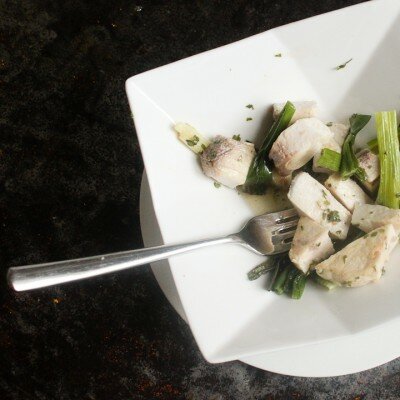
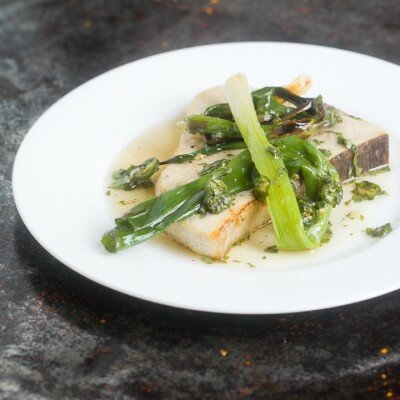
Swordfish Salad w/ Thai Dressing and Broiled Scallions
Serves 4
1 ½ pounds swordfish
2 bunches scallions, trimmed
sliced mint
olive oil
salt and pepper
For the Dressing:
¼ cup fish sauce
2 tablespoons water
2 tablespoons sugar
1 tablespoon rice vinegar
juice 1 lime
1 minced garlic clove
1 minced fresh red chile
- Rub fish all over with a bit of olive oil and lay on rack over a foil-covered baking sheet. Season both sides with salt and pepper. Toss the scallions with oil. Preheat the broiler. Place on a rack with scallions. Place on a rack just under the heat. Depending on thickness, the fish will take 6-7 minutes, flipping once, and scallions 3-4. You want the veg just cooked through and just a little browned, not charred. Remove, let cool and refrigerate. When cold, cut fish into ½ inch pieces and the scallions into 1-inch lengths.
- Whisk the dressing ingredients until the sugar completely dissolves. Gently toss the fish and scallions in a bowl with the dressing and mint. Season as desired and serve.
Broccoli Stem and Floret Salad
A culinary student colleague, returning from an internship at Daniel told me the experience was generally crummy. One can only tolerate being called a jackass in French for so long. Most astonishing was the sheer waste: a celery stalk is reduced to a precisely measured pile of brunoise barely able to fill a demitasse spoon. A parsnip yields a few wispy threads destined to be dropped ever so delicately into the fryer and cooked to the color of the late afternoon sun.
A restaurant is medieval in structure, gentry in the front, serfs (slaves?) in the rear, which, as it happens, is chock full of period appropriate torture instruments: raging fire, boiling oil, and severe taskmasters. And the persistent fear of infiltration by a fierce power – the INS.
In another genuine touch, the cooks are fed scraps shaved from whatever feast is shipped to the paying diners. In an odd way, however, this phenomenon, the staff meal, should serve as a valuable modern day lesson to us all. Nothing is wasted; bits of veg and meats are turned into stocks and soups and stews and sandwiches and so on, most of which, due to lack of time, are pitifully flavored, but can be, in the leisurely environment of the home cook, turned into satisfying meals.
Nowadays, a chef is measured by his nose-to-tail skills; can he transform every last part of the pig into a delicious morsel. For some reason, especially at home, vegetables are not given the nose-to-tail respect; lop off the broccoli florets and chuck the stem; throw out that unused quarter of a fennel or half a shallot.
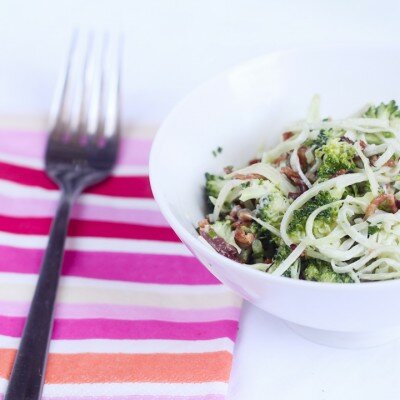
While it would be nice to read less about nose-to-tail and more about stem-to-stalk, the home chef should take a page from the restaurant kitchen and use up these bits and pieces. Stuff can be turned into pickles or relishes, chutneys, etc. And it’s a sin to dump something as worthy as a broccoli stalk, which is the moral of today’s post, the all-broccoli salad, or in chefy terms, broccoli two ways. A worthy recipe in the savvy, thrifty spirit of the modern galley workers.
(NOTE: 1. If you don’t have a mandoline, this is the time to buy one. 2. The amounts are purposely vague (you should know how you like your dressing), the only caveat being not to make it too thick and not to overdress. It’s a delicate salad, the last thing you need is soggy, heavy veg.)
Salad of Broccoli Stems and Florets
Serves 4
2 medium bunches broccoli
2 slices bacon
chives
buttermilk
sour cream
touch olive oil
salt and pepper
- Bring a large pot of salted water to boil. Have bowl of ice water nearby.
- Cut off florets into 1/2 –inch size. Using a paring knife, peel stem from end to end, removing tough exterior. Slice peeled stems into strips, ¼-inch thick and about 2 inches long, stack, then julienne. Alternatively, use a mandoline and make your life easier. Keep florets and stems separate.
- Blanch florets very briefly, no more than 30 seconds-they should still have bite. Repeat with julienned stem. Use a slotted spoon to transfer the vegetables to ice water.
- Saute the bacon and crumble. Reserve on a paper towel
- In a small bowl, whisk buttermilk and sour cream to a dressing consistency (not too thick – SEE NOTE). Add a touch of olive oil and season well with salt and pepper. Toss and serve.
Asparagus and Eggs

Vague food is, and has been, central to the fabric of American home cooking. Time crunch, disinterestedness, whatever: come evening, a gaze into kitchens would reveal arms rustling through cabinets, heating a pan or two, reaching for the nearest utensil, and stirring. Door-to-door-in this case, counter to table-in half an hour or less.
The family sitting down to dinner, staring at their plates with a combination of fear and confusion, is an iconic image, to wit, the mashed potato tower in Close Encounters. Actually, mashed potatoes are the perfect example of desperately hasty cooking: mush. But at least it comes (usually) from a vegetable.
Random ingredients, often canned, introduced to heat, produce, you guessed it, soft food. And so we get weird casseroles, soups, and egg dishes. Canned food is a staple of mystery food. However, cans are lonely: they were designed for ease and storage, not cooking i.e. combination with any other earthly product. Mixing anti-social items in a pan makes for a sad meal.

To free yourself from this awkward party is not to cook with an actual, clear dish in mind, but rather, with a few things that you know go together. You may not be able to name the dish: sandwich, soup, etc. But it will taste fine, which is all that matters. And if, in the process, it looks nice, that’s a bonus.
This one was the result of pantry scrambling, and I’m not sure what to call it. It’s kind of an appetizer, but had I found more asparagus and eggs in the fridge, I’d be comfortable calling it a salad. Either way, it looks nice, tastes nice, and is neither soft nor scary. I’d make it again, only as a big salad. For now, I don’t have a label. But I ate it with a smile.
Asparagus and Eggs
Serves 1
4 thin asparagus, trimmed of woody end
1 egg
1 teaspoon grain mustard
3 tablespoons olive oil
salt and pepper
- Bring a medium pot of salted water to boil, carefully add the egg and cook 13 minutes. Near the end of cooking, add asparagus to pot as the egg cooks, and blanch 3-4 minutes, making sure they’re still crisp. Remove and dry on a paper towel. Slice in coins ¼ inch thick. Add to a bowl.
- Remove egg, and when cool, peel and halve. Season.
- Whisk mustard and oil in a small bowl, season with salt and pepper. Toss with asparagus, top with egg. Serve warm.
Vietnamese Peanut Sauce

Fish sauce is one of my great culinary discoveries. Not cooking with it, mind you, but the only way truly to appreciate fish sauce: spilled on the floor. You see, don’t cry over spilt milk is nice and all, but you probably should cry over spilt fish sauce.
I was in cooking school and a tray containing several half-closed bottles tipped out of its slot in the cart and crashed to the ground, splattering the stuff all over the white tiled floor. It was like when the chem. teacher magically altered the color of flame: an instant reek arose from that shiny floor like a fishy nuclear cloud.
In fact, fish sauce, like wine, is chemistry in a bottle: a product of fermentation, in this case fish rather than grapes. But the idea is the same: take a natural product and let it rot until it’s really tasty. Of course, spoiled grape juice sounds better than spoiled fish, but without fish sauce there’d be no Vietnamese food, and I’d rather live in a world without wine than a world without Vietnamese fare.
Yet fish sauce, by itself in, say, a cup, is pretty gross. You need to mix it with other stuff, which is how we come to the other wonder of this cuisine: the marriage of these seemingly yucky products. It can act like salt, seasoning rice and other items, but it’s magical when whisked with lime juice, a little sugar, shallots, and herbs; squirted in to finish a curry; or sizzled at the end of a simple stir fry.
In this dish, it’s stir fried with ground pork and two other items which aren’t great on their own: tamarind water and fermented soy bean paste. Add a little water and you have a slightly chunky sauce to be used as a dip for vegetables, noodles, salads, etc. On paper it reads like the recipe for a nasty fraternity drink: scoop a bunch of stuff into a cup and drink. But this funky marriage works beautifully. Just don’t spill it on the floor.
(NOTE: tamarind water is essentially the strained liquid from tamarind pulp mixed with water. For the offbeat ingredients, go online. Our Thai market is Bangkok Center Grocery-they have a website. The sauce goes well served as a dipping sauce for vegetables. You can pour it hot over a salad of cilantro, scallions, and lettuce with or without beef or chicken.)
Vietnamese Peanut Sauce (from Hot, Sour, Salty, Sweet)
¼ cup roasted peanuts
2 teaspoons peanut oil
4 cloves garlic, minced
3 tablespoons ground pork
3 tablespoons fermented soybean paste (dao jiao in Thai) (NOTE)
2 tablespoons tamarind water (see NOTE)
1 cup water
1 ½ teaspoons sugar
1 or two bird chiles, minced
squeeze lime juice
- Grind peanuts to a coarse powder and reserve.
- Heat a wok or skillet with the oil over high heat. Add garlic, cook 15 seconds till lightly colored then add pork. Break it up, and when changed color, add tamarind water and soybean paste, stir.
- Add ½ cup water, most of the peanuts, sugar and chilies, and stir. Add up to ½ cup or more of the water. It shouldn’t be a thick liquid, not watery.
- Use as a dipping sauce for vegetables, to pour over salads or stir fries.
Beets and Goat Cheese

Beets and goat cheese is a natural combination. Beets and any kind of cheese, I guess. I like my beets smoking hot just out of the oven, but I’ll take them alongside a wedge of fromage.
The problem with pairing cheese with beets is that beets make such a mess, dying everything they touch, that you have to be uncomfortably delicate. I worked in a restaurant-a poorly run and subsequently shuttered one-which served them stacked, napoleon style. To slice the goat cheese, the chef used one of those taut string devices I hadn’t seen since 6th grade pottery when the teacher used it to cut up wet clay.
He lifted and gingerly layered the two so that the beets didn’t dye the cheese. A needless pain in the butt, I thought, but his problem.

Until it became mine, and I found myself working with this oversized length of dental floss, barely resisting the urge to tell him there must be a better way. Years later, I believe I devised an easier method to cut the cheese, as it were. You treat it like pie dough: roll into a disc, wrap, and chill. Remove from the fridge, lay it between two sheets of plastic, and roll thinly. Finally, use a small ring mold to cut circles, which you then chill. Voila.
Of course, you could plate the beets and cheese some other way, but, stacked, they look kind of cool, like a savory candy cane. You still have to watch out for that infernal beet dye: a pair of latex gloves comes in handy, as does a tiny spatula. But, slicing and stacking, I cheerfully thought of those past bosses and teachers who did things the wrong way. All it took was a little goat cheese and a few beets.
Beet and Goat Cheese Napoleon
Makes about 4 appetizers
1 large bunch beets
8 oz plain goat cheese, sliced into two pieces, cold
tiny greens
salt and pepper
- Preheat the oven to 450.
- Trim the beets, wrap in foil and roast until tender, 1 to 1 ½ hours. Remove, peel, chill in refrigerator.
- Meanwhile, remove the goat cheese from the fridge. Roll each into a ball and form into a disc, about 6 inches by 1 inch. Return to refrigerator for 20 minutes.
- Remove goat cheese, place each between two large sheets of plastic wrap and, using a rolling pin, roll as you would a pie dough, into a circle, until about 1/16 inch thick. Return to fridge.
- Remove and, using a 2-inch ring mold, cut circles from the cheese and refrigerate. When the beets are cold, slice into equally thin rounds, stack, and use the same mold to cut equivalent small circles. Season with salt and pepper.
- To assemble, set the beet tray next to the tray with the goat cheese and, using a small spatula or butter knife create your napoleon, beet on the bottom. Alternate until you have about two or three slices of each and finish with the beet. Serve garnished with microgreens.
Gravlax w/ Fried Artichoke Leaves

What if instead of sitting down to a bowl of spaghetti or a plate of chicken we picked from a tray of canapés? It’s more social than “family style” food; handing over a giant bowl of food is for amateurs. With a canapé dinner, the table would become a great tangle of arms as people reached for their morsels of choice. And yet because canapés sound fancy with its French name, the jostling would be surprisingly polite, like when someone knocks into you on a crowded subway and apologizes rather than tells you to drop dead.
I mulled this over while nibbling on some paper-thin slices of gravlax and watching one more Jets season go up in flames. The silky salmon with its traditionally subtle mix of salt, sugar, and fresh dill, was quite delicious. The only thing missing was a little basket of pumpernickel toast points. And maybe a guy passing a tray of mini sliders (is that redundant?) or shrimp cocktail.

If you’re looking for the true family experience, having a loved one serve you waiter-style would be even more bonding, a true sign of giving and devotion. I could go on, but the quail eggs are boiling and the cucumber sandwiches seem to be getting a little soggy.
(NOTE: frying the leaves isn’t as hard as it sounds, though they do tend to burn. Make sure the oil isn’t too hot, stir with a slotted spoon, and remove when they gain color. I haven’t had too much success in a standard blender with the alioli; barring a stick blender, break out the whisk and make it the old fashioned way.)
Gravlax w/ Fried Artichoke Leaves
Makes enough for a few people to snack on for about an hour. Or 4 fancy appetizer plates. Or a platter for 4.
1 pound salmon fillet
1/3 cup kosher salt
1/3 cup sugar
½ bunch dill, chopped finely
1 lemon, sliced in thin wedges
Fried Artichoke Leaves (see below)
Alioli (see below)
1. Mix the salt, sugar, and dill in a small bowl. Spread half of it on a large piece of plastic wrap. Top with the salmon, skin down. Pour the rest over the fish and wrap tightly. Place in a shallow dish, like a pie dish and weigh down with a heavy baking dish. Refrigerate for 2 days.
2. Remove the salmon, slice paper-thin and arrange on cold plates with the artichokes, lemon, and alioli.
Fried Artichoke Leaves
1 artichoke
1 lemon, halved
oil for frying
kosher salt
- To prepare the artichoke: peel off and discard all the dark green leaves, stopping when you’ve reached bright yellow leaves. Using a sharp knife, lay the artichoke on its side and cut off about half an inch from the top. Discard. Next, cut across just above the heart, a few inches down. Save these leaves for frying, If any are too green, discard, as they’ll be too chewy. Rub the body of the artichoke with the lemon to prevent discoloring. Cook it and eat. We’re worried about the leaves here.
- Over medium high heat, bring about 2 inches of oil in a large pot to 325 degrees. Add the leaves in small handfuls and fry until golden but not burned. The center should still be light colored. This takes some practice and about 30 seconds to 1 minute. (see Note)
- Drain on paper towels, sprinkle with salt.
Alioli
Makes about 2 cups
4 garlic cloves, peeled, chopped finely
3 tablespoons water
1 cup oil, ½ olive and ½ canola
juice half of a lemon
salt and pepper
1. Add the water and garlic to the bowl of an immersion blender. Slowly pour in the oils, blending, until emulsified. Season with the lemon juice, salt, and pepper. To make without an immersion blender, mince the garlic to smooth paste, add to a bowl with the water, and slowly whisk in the oils.
Green Papaya “Noodles”

One measure of a great cuisine is its malleability. Can it rise and fall in waves, and thrill at the crest as well as the trough? And does it involve green papaya?
If you guessed with Thai and Vietnamese food, you win the prize. It satisfies both requirements. The flavors are musically infinite: fragrant Thai basil and lemongrass; sweet, caramel palm sugar; sharp galangal; rich coconut; hot chilies; and so on. As well as a field of wild leaves, berries, and grains. Meat and fish are important, but not central; they are treated with no more or less respect than the other ingredients, certainly far different from the Western approach.
Green papaya is highly emblematic of Thai and Vietnamese food. For one, it possesses the incredible property of tastelessness. Try a small chunk of green papaya; cleanse the palate. Now suck on a leg of your kitchen table. Not too different. Except for the vegetable’s marvelous, radish-like crunch. Green papaya is a truly blank slate-bland yet wonderfully crunchy.

Because cooking kills the crunch, it’s must be used raw, preferably in a fresh salad, which is why it’s perfect for this style of food. You see, the perfect Thai/Viet spread includes not just rich (and delicious) curries, but fresh, light salads. Acid elements such as rice wine vinegar, fish sauce, and cut limes are always present. Even fried spring rolls are accompanied by fresh mint and lettuce.
Don’t get me wrong, I love Chinese food, but the last Chinese salad I ate involved beef and broccoli. Still, the stained menu from our local Chinese takeout joint is a near sacred document, so it seems almost heretical to present this dish, but in a way, it’s a high compliment. Lo mein will forever grace our tables, but so will a cool Thai salad. And in life, when you’re hopelessly undecided, stick something in a Chinese takeout container.
(NOTE: I do possess a small mortar and pestle, and as much as I avoid using it, it really is effective here. Crushing rather than chopping up the garlic, chilies, and lime, add a punch and unique appearance. However, you can, of course, chop in a mini blender. Just be sure to more or less mince the items. Sticking a large lime piece in that thing might present some issues. Also, palm sugar is so good here it’s nearly indispensible, but again, brown sugar is fine.)
Green Papaya Salad
Serves 4
3 garlic cloves
2 tablespoons roasted peanuts, coarsely crushed
6 cherry tomatoes, quartered
2 slices lime
4 Thai chilies
1 green papaya, julienned finely
3 tablespoons palm sugar or brown sugar
4 tablespoons fish sauce
½ tablespoon soy sauce
3 tablespoons lime juice
- Using a mortar and pestle, crush the garlic gloves, peanuts, tomatoes, lime slices, and chilies to a coarse paste. (see note).
- In a small bowl, whisk the fish and soy sauces with the palm sugar and lime juice. Crush the sugar so that it dissolves.
- Add the green papaya to a large bowl. Toss with the fish sauce mixture, then the garlic mixture. Season with more fish sauce or lime juice if necessary.
Beet Tartare

Last week Frank Bruni had a typically wry piece on Romera, the new ultra luxurious Manhattan restaurant. Several clichés seem to apply to this place: “highly anticipated”, “the new in-spot”, “tough reservation”, etc. But, as Bruni wrote, pretentious is the most apt description. Or, if you must, “over-the-top”.
Rather than pairing wines to food, apparently-and this is part of the restaurants “philosophy”, if you will-Romera pairs infused waters. While I’m mildly curious to taste leek water, or whatever, I doubt it’s worth the $250 check. Pretentious, yes, novel, no. Chefs have been playing with chemistry for quite a while now, inverting peas, reversing eggs, deconstructing chocolate, and so on. Michel Richard transforms pasta into tiny black droplets, packs them into a tin and calls it caviar. Others-and this is apparently common-spoon mango puree in the center of a white emulsion and call it a fried egg.
A chef who engages in this sort of trickery needs to step out of the kitchen. Uniformly, the best chefs say they cook what they like to eat. While it may be fun to play with, I doubt these guys like to kick back with a plate of transglutaminase and various forms of calcium.
It is, on the other hand, kind of nice (and endearingly honest) to play with the labels, as long as the intent is not fanciful recreation. Beet tartare is a tasty and appropriately playful take on the classic steak version. While you’d never mistake minced beets for ground filet, and the mix-ins are wholly different, the result is strikingly attractive, delicious, and playful.
Beets are also a hell of a lot cheaper than filet, and certainly less expensive than a night at Romera. It doesn’t involve test tubes and leeky water, just old-fashioned cooking with a pleasantly modern twist.
(NOTE: you’ll see we don’t call for tossing the beets with the herbs and crème fraiche, which is the point. It’s a “steak” tartare, as in mix it yourself.)
Beet Tartare
Serves 4 as an appetizer
1 bunch large beets
2 tablespoons olive oil
handful (1/2 cup) of mixed fresh herbs such as tarragon, dill, and parsley, chopped
3 tablespoons minced shallots
1/2 cup crème fraiche or sour cream
salt and pepper
- Preheat oven to 400.
- Coat beets in oil, wrap tightly in foil and roast till tender. Don’t overcook-it’s a salad. About 1 hour or more.
- Remove. When cool, peel using a paring knife and cut in small (1/8 inch) dice. Chill in fridge for at least an hour.
- Season the cold beets with salt and pepper. To serve, divide in small bowls or plates, top each with the herbs and shallots and follow with a spoonful of crème fraiche in the center.
When a Radish is a Beet

A culinary degree prepares you for being a chef about as much as a B.A. in chemistry prepares you to be a neurosurgeon. It’s a lesson soon learned when thrown (literally) into the fire in a professional kitchen and berated for being too slow or being too fast or burning something or leaving something in the wrong place committing a host of seemingly insignificant errors.
Part of this is kitchen culture, but most is due to the intense and, frankly, unrealistic pressure to push food out the doors to an ungodly number of hungry diners. The lone way to prevent nervous meltdowns is to turn the cooks into a smooth engine whose parts (the staff) work in synch. When you think about it, it’s a miracle a basket of bread gets to the table.
However, culinary school does serve one purpose (other than bankrupting its students): it gives one a semi-official imprimatur, a certificate of admittance into the food fraternity. You can wander through the food world with a sense of belonging. Whether or not you know anything is a different question. Is someone with a B.A. in English a better reader than the guy you last sat next to on the subway?
Anyhow, for us, culinary school is many moons ago, and I like to think we know what we’re doing. We cater parties; we keep up with trends and the rest. We’ve learned to sift through the mountains of food junk out there (overhyped restaurants, bad and overpriced greenmarket produce) and pick out the best (Kalustyan’s the spice guy, our Vietnamese market on Mosco Street), compiling a pretty solid understanding of what to do with what’s available.
We deal with Pino our fantastic neighborhood butcher, and look for the best ingredients around.
And yet, a gardener I’m not. We live in New York City for chrissakes. My idea of recreation is trying desperately not to get hit by Jersey drivers edging greedily towards the Holland Tunnel. Once we grew basil the windowsill until an attack of aphids forced us to bag them up and bring them downstairs to Alphonso who mans the garbage room. I could garden indoors, but prefer an unobstructed street view and sun access. This is New York, after all.

And so we come to beets and radishes. This month we’re on the Cape. Blackberry bushes surround the house much like Gingko trees carpet the upper east side. A cute line of grape vines runs up the hilly lawn, and a fruit tree in the back drops something green and weird that looks like a lime.
It’s a nice bike ride over back roads lined with trees and open meadows. The other day we biked to the Wellfleet farmers’ market and snatched up a nice bunch of radishes for our summer staple salad of radish, cucumber, and sour cream. Sliced paper thin on the mandolin, they were pretty discs of red and white concentric circles, which, tossed with the cukes, made for a lively bowl. It seems we had lucked out on some eccentric, beautiful radishes.
Until the mandatory tasting when we discovered our lovely radishes were, in fact, lovely beets. Some variety whose deviously cute interior was engineered to fool the shopper and wreck his radish cucumber salad.
Having already photographed, posted, and labeled as radishes a pic of these cute bulbs with their candy cane cross sections, I knew someone out there in food nerddom would catch the grave error and I was right. “Aren’t those Chioggia beets?” burst the tweet. “Of course, I wrote, our mistake.”
You learn something everyday, but some things aren’t necessarily worth learning. Yes, it’s a cute little beet, but I tried it, and a thin slice tastes just like a thin slice of your average red beet. It’s nice to discover the Chioggia beet, but I’d rather craft a great short rib recipe or understand curry leaves or figure out the recipe for the steamed shrimp and coconut pudding at Co Ba.
Culinary school opened the door to the food world, a place I’m happy to inhabit. But I’m not a gardener and never will be. And I’m cool with that.
When a Radish is a Beet

(radish?)
A culinary degree prepares you for being a chef about as much as a B.A. in chemistry prepares you to be a neurosurgeon. It’s a lesson soon learned when thrown (literally) into the fire in a professional kitchen and berated for being too slow or being too fast or burning something or leaving something in the wrong place committing a host of seemingly insignificant errors.
Part of this is kitchen culture, but most is due to the intense and, frankly, unrealistic pressure to push food out the doors to an ungodly number of hungry diners. The lone way to prevent nervous meltdowns is to turn the cooks into a smooth engine whose parts (the staff) work in synch. When you think about it, it’s a miracle a basket of bread gets to the table.
However, culinary school does serve one purpose (other than bankrupting its students): it gives one a semi-official imprimatur, a certificate of admittance into the food fraternity. You can wander through the food world with a sense of belonging. Whether or not you know anything is a different question. Is someone with a B.A. in English a better reader than the guy you last sat next to on the subway?
Anyhow, for us, culinary school is many moons ago, and I like to think we know what we’re doing. We cater parties; we keep up with trends and the rest. We’ve learned to sift through the mountains of food junk out there (overhyped restaurants, bad and overpriced greenmarket produce) and pick out the best (Kalustyan’s the spice guy, our Vietnamese market on Mosco Street), compiling a pretty solid understanding of what to do with what’s available.
We deal with Pino our fantastic neighborhood butcher, and look for the best ingredients around.
And yet, a gardener I’m not. We live in New York City for chrissakes. My idea of recreation is trying desperately not to get hit by Jersey drivers edging greedily towards the Holland Tunnel. Once we grew basil the windowsill until an attack of aphids forced us to bag them up and bring them downstairs to Alphonso who mans the garbage room. I could garden indoors, but prefer an unobstructed street view and sun access. This is New York, after all.

(beet)
And so we come to beets and radishes. This month we’re on the Cape. Blackberry bushes surround the house much like Gingko trees carpet the upper east side. A cute line of grape vines runs up the hilly lawn, and a fruit tree in the back drops something green and weird that looks like a lime.
It’s a nice bike ride over back roads lined with trees and open meadows. The other day we biked to the Wellfleet farmers’ market and snatched up a nice bunch of radishes for our summer staple salad of radish, cucumber, and sour cream. Sliced paper thin on the mandolin, they were pretty discs of red and white concentric circles, which, tossed with the cukes, made for a lively bowl. It seems we had lucked out on some eccentric, beautiful radishes.
Until the mandatory tasting when we discovered our lovely radishes were, in fact, lovely beets. Some variety whose deviously cute interior was engineered to fool the shopper and wreck his radish cucumber salad.
Having already photographed, posted, and labeled as radishes a pic of these cute bulbs with their candy cane cross sections, I knew someone out there in food nerddom would catch the grave error and I was right. “Aren’t those Chioggia beets?” burst the tweet. “Of course, I wrote, our mistake.”
You learn something everyday, but some things aren’t necessary worth learning. Yes, it’s a cute little beet, but I tried it, and a thin slice tastes just like a thin slice of your average red beet. It’s nice to discover the Chioggia beet, but I’d rather craft a great short rib recipe or understand curry leaves or figure out the recipe for the steamed shrimp and coconut pudding at Co Ba.
Culinary school opened the door to the food world, a place I’m happy to inhabit. But I’m not a gardener and never will be. And I’m cool with that.