Dinner
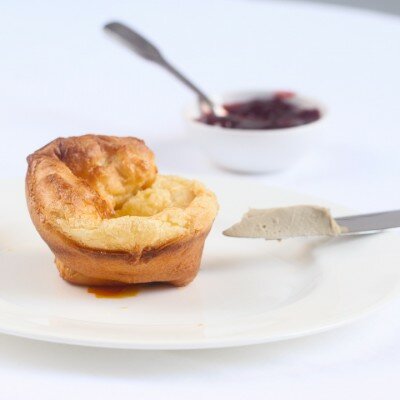
Yorkshire Puddings w/ Foie Gras and Strawberry Preserves
 Cheetos are a miracle of science. Consider the recent NYT magazine cover story on food conglomerates and their efforts to hook the public on their products. Of the chips, processed lunch meats, and sugary sauces, I was most impressed with the Cheeto. Not only does it crunch, but it pleasingly melts in the mouth, wherein lies a key added benefit: we tend to think airy, delicate foods are harmless. And so we keep dipping our orange hands into the Cheeto bag.
A morsel that both dissolves and addicts: genius. The first Cheeto emerged from a bubbling test tube, huddled over by a mob of lab-coated food scientists. Like a novel, it transformed from a dreamy vision into a real live object. But in the obsession with all things modern (see ipad, etc.), we lose sight of the past and the fact that all culinary history is full of experimentation.
Take Yorkshire pudding, for instance. As a rule, any expanding food, be it a Cheeto, Yorkshire pudding, or a loaf of bread, is the product of trial and error, in other words, the scientific method. A tiny amount of batter ladled into a hot muffin tin blows up into a golden, yummy balloon. The first gal to crack open the oven and witness this event must have fainted right into her tub of freshly churned butter.
Cheetos and Yorkshire Pudding: pools of liquid puffed up into addictive treats. Both products of food experimentation, the former was created with the intent of hooking consumers. Scientists tested sugar, salt, and crunch metrics with the precision of researchers hunting for a cancer cure.
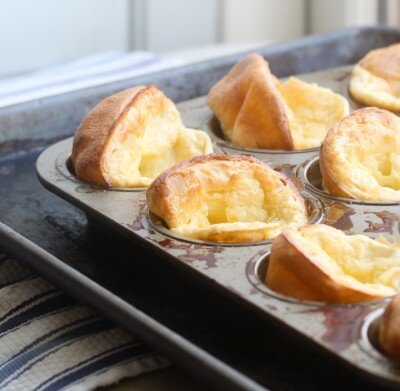
Yorkshire Pudding may not be the perfect food (to my mind, the Dorito is unsurpassable), but they’re honest, successful and absurdly simple examples of kitchen chemistry. Fresh out of the oven, these things are plenty addicting, but if you want to be like the Cheeto guy, serve them as we do here, with a spoonful of foie gras mousse and strawberry preserves.
Yorkshire Pudding w/ Foie Gras and Strawberry Preserves
Makes about 12 Y.P.’s
1 cup flour
4 eggs
1 ¼ cup milk
pinch salt
canola oil
foie gras terrine
strawberry preserves
1. Preheat oven to 450.
2. In a medium bowl, whisk salt and flour. Whisk in eggs until very smooth. Whisk in half the milk, then the remaining half. Transfer to a measuring cup and let rest.
3. Add a teaspoon of oil to each compartment of a 12 tin muffin pan. Place in oven until oil is extremely hot. Swirl around carefully.
4. Fill muffin tins about ¾ full. Bake about 15 minutes until golden and puffy. Serve with foie gras and jam.
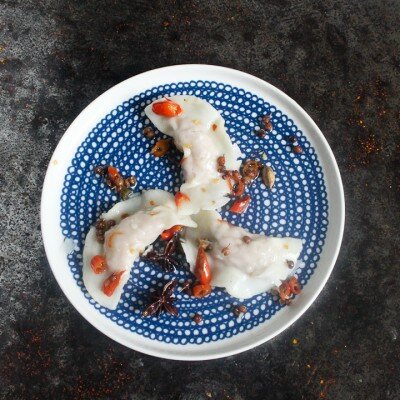
Dumplings Dressed with Whole Spice Chile Oil
Lunch in my old school was-throughout my twelve years of attendance-crummy at best. You learned to avoid anything heated even slightly beyond room temperature. In such a situation, one needs a bailout, and ours was laid out on a small folding table. An appendage to the end of the counter on which we slid our trays, the table held torn open bags of white bread, a large bowl of butter, and an equally sizeable aluminum tin of peanut butter. And so, mood-depending, I’d work my way through the week fortified by butter and peanut butter sandwiches.
Nowadays, supposedly things have changed: the food is better, more varied, and generally pleasing. Which isn’t much to ask for considering the tuition. Still, one wonders how to elevate institutional food from the nearly decent to the relatively good (adverbs are unavoidable when discussing this subject).
The answer to this conundrum hit me on the 6 train, my eyes buried in our recent copy of Saveur, admiring the article on spicy Chinese cooking. Saveur is a shabby chic version of National Geographic: meandering travel writing which assiduously dodges revolutions, slavery, and bloodshed, instead focusing on, say Rwandan goat curry. Or an essay on a lovely Iraqi family and its bread recipes minus any mention of them eating their meals in a bomb shelter.
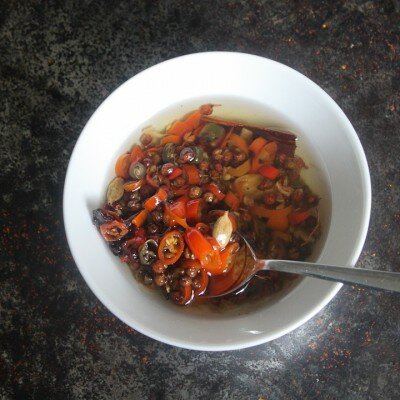
Nonetheless, occasionally they publish a potentially exciting recipe. For instance, this week’s red chile oil straight from spicy China. Rather than a simple chile-oil infusion this version contains other, more fragrant and unexpected spices such as cloves and cardamom.
Which brings me back to school food. How about a line of garnishes, a little red chile oil, some flavored salt, and so on. Not only to improve the fare, but also expand young palates. Unless the idea of private school kids sprinkling clove dust on their curry nauseates you. In which case, just make this stuff at home and keep it in the
fridge to help your cooking.
(NOTE: as you can see in the picture, we didn’t strain the oil. This is more for photographic aesthetics, however, since the oil contains its own garnish, no harm in using some for flair.)
Whole Spice Red Chile Oil (from Saveur)
2 cups canola
4 star anise
3 cloves garlic, smashed
3 cardamom pods
3 cloves
2 bay leaves
1 stick cinnamon
1 3” piece ginger, smashed
1 cup fresh red Thai chiles (they say chiles de arbol, we used Thai), chopped
3 tablespoons Szechuan peppercorns
1 tablespoon soy sauce
½ teaspoon salt
- Heat everything up to (not including) the chiles in a medium pot over medium heat until garlic is golden, about 10 minutes.
Transfter to a heatproof glass jar, with chiles, peppercorns, and salt. Let cool to room temp. Discard garlic and ginger, seal and let sit for 24 hours. To use, strain oil, discarding solids. Keeps in fridge 3 months.
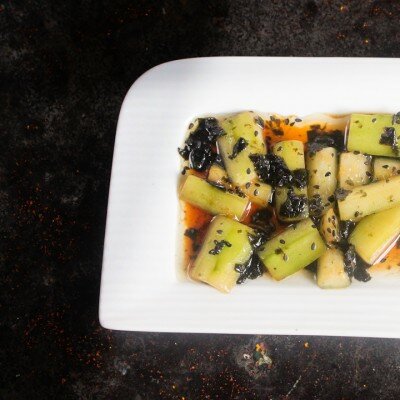
Warm Cucumbers with Nori Dressing
Intro to a duck a l’orange recipe, source to be named later:
“This classic dish displays all the talents of the saucier, a position normally reserved for the most qualified cook in the kitchen. Duck a l’orange brings out his talents to combine three distinctly different flavors.”
Given the dish (dated) and the pedantic tone, you’d think perhaps Escoffier or a cooking school textbook (I know it sounds like ours, with its soufflé and mousse addiction). But it’s from the Balthazar cookbook, one of our favorites, for its food clear directions, and structure, but moreso its honesty: the dishes seem simple but spring from years of toil, a fact which, despite the seeming simplicity of the recipes, comes through loud and clear.
Like the Federer forehand, the Balthazar book embodies one of my favorite sayings: “he makes it looks easy”. It’s a good measure of excellence; if something looks like a breeze, it’s probably exactly the opposite. Of course, it goes around and around: what looks easy should be easy and thus generally doable.
But it’s not, which is where the obnoxious American enters the picture. The football fan screaming at that bastard who “somehow” fails to catch a badly overthrown ball. The superhuman leap, which leaves the player’s knees hanging in the air ready to be torn off by an angry giant, is forgotten. Or the restaurant critic reaming a chef who fails to produce a perfect plate of food; the dance critic wondering how a ballerina could have slipped.
The unfortunate reality is that excellence is the result of hard work. In this respect, good cooking is deceptive: tasty dishes with a limited ingredient list, are often the product of more blood sweat and tears than something molded, stuffed, wrapped, braised, sautéed, chilled, sliced, and glazed with aspic.
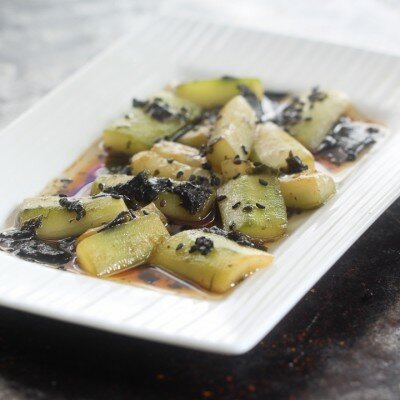
The sauce in this recipe is really good; it pairs perfectly with a quick cucumber sauté. We got it from, the Japanese chef Tetsuya Wakuda, who spoons the stuff over rare salmon. It’s a simple mixture, or should I say, he makes it look simple, which is high praise indeed.
Warm Cucumber With Nori Dressing
Serves 4 as a side dish
2 seedless cucumbers
1 sheet nori crumbled into small flakes
1 ½ tablespoons soy
2 tablespoons mirin
¼ cup rice vinegar
1 tablespoon sesame oil
1 teaspoon sugar
¼ cup olive oil plus 2 tablespoons
pinch salt
1 tablespoon black sesame seeds
- Peel and halve the cukes lengthwise. Remove seeds with a spoon. Slice halves widthwise in 1 inch pieces then cut the sections in half to form pieces about 1 by ¼ inch. Reserve in a bowl.
- Make the dressing: in a medium bowl, whisk the ingredients together except for the nori and the 2 tablespoons olive oil. Stir in the crumbled nori. Let sit ½ hour.
- Heat the two tablespoons oil in a large sauté pan over medium high heat. When hazy, add the cucumbers and saute, stirring occasionally, for about 2 minutes or until warmed through and tender but not overcooked. They should have a bit of a bite.
- Pour the warm cucumbers into the bowl with the dressing, toss, and serve on a platter.
Broccoli Stem and Floret Salad
A culinary student colleague, returning from an internship at Daniel told me the experience was generally crummy. One can only tolerate being called a jackass in French for so long. Most astonishing was the sheer waste: a celery stalk is reduced to a precisely measured pile of brunoise barely able to fill a demitasse spoon. A parsnip yields a few wispy threads destined to be dropped ever so delicately into the fryer and cooked to the color of the late afternoon sun.
A restaurant is medieval in structure, gentry in the front, serfs (slaves?) in the rear, which, as it happens, is chock full of period appropriate torture instruments: raging fire, boiling oil, and severe taskmasters. And the persistent fear of infiltration by a fierce power – the INS.
In another genuine touch, the cooks are fed scraps shaved from whatever feast is shipped to the paying diners. In an odd way, however, this phenomenon, the staff meal, should serve as a valuable modern day lesson to us all. Nothing is wasted; bits of veg and meats are turned into stocks and soups and stews and sandwiches and so on, most of which, due to lack of time, are pitifully flavored, but can be, in the leisurely environment of the home cook, turned into satisfying meals.
Nowadays, a chef is measured by his nose-to-tail skills; can he transform every last part of the pig into a delicious morsel. For some reason, especially at home, vegetables are not given the nose-to-tail respect; lop off the broccoli florets and chuck the stem; throw out that unused quarter of a fennel or half a shallot.
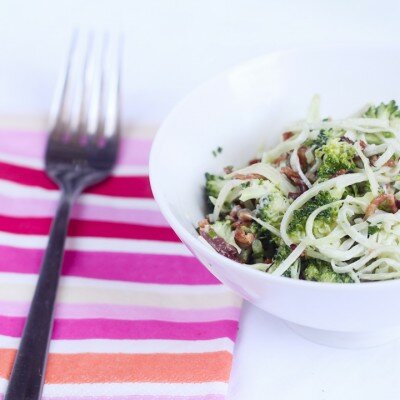
While it would be nice to read less about nose-to-tail and more about stem-to-stalk, the home chef should take a page from the restaurant kitchen and use up these bits and pieces. Stuff can be turned into pickles or relishes, chutneys, etc. And it’s a sin to dump something as worthy as a broccoli stalk, which is the moral of today’s post, the all-broccoli salad, or in chefy terms, broccoli two ways. A worthy recipe in the savvy, thrifty spirit of the modern galley workers.
(NOTE: 1. If you don’t have a mandoline, this is the time to buy one. 2. The amounts are purposely vague (you should know how you like your dressing), the only caveat being not to make it too thick and not to overdress. It’s a delicate salad, the last thing you need is soggy, heavy veg.)
Salad of Broccoli Stems and Florets
Serves 4
2 medium bunches broccoli
2 slices bacon
chives
buttermilk
sour cream
touch olive oil
salt and pepper
- Bring a large pot of salted water to boil. Have bowl of ice water nearby.
- Cut off florets into 1/2 –inch size. Using a paring knife, peel stem from end to end, removing tough exterior. Slice peeled stems into strips, ¼-inch thick and about 2 inches long, stack, then julienne. Alternatively, use a mandoline and make your life easier. Keep florets and stems separate.
- Blanch florets very briefly, no more than 30 seconds-they should still have bite. Repeat with julienned stem. Use a slotted spoon to transfer the vegetables to ice water.
- Saute the bacon and crumble. Reserve on a paper towel
- In a small bowl, whisk buttermilk and sour cream to a dressing consistency (not too thick – SEE NOTE). Add a touch of olive oil and season well with salt and pepper. Toss and serve.
Spaghetti with Saffron Cream and Chilies
Given the fascinating degree of human variation, from DNA (useful in fighting crime) to eye color (useful in not much), it’s interesting that tourist-choked Broadway is a study in similarity. In other words, we look so alike that a 5’6” guy is considered on the short side-a difference of only a few inches from “the norm”-and surplus of a mere 20 pounds or so is thought of as distinctive.
However, there do exist on this earth, people who are truly different: they may best be seen courtside at your local NBA arena, the land of the super-tall, where 6’1 is a height worthy of compassion, a look that says “what a sweet little guy”. Bill Walton strolled past me once on the way to the announcer’s table, and it was like being nudged by a walking palm tree.
Reading a recipe the other day, Knicks game in the background, I considered the definition of “pinch”, the most common-yet universally accepted-imprecise quantity cookbook suggestion. I appreciate imprecision in recipes, actually: it carries an air of creativity and whimsy to cooking, so often “constipated” (in Roux brothers’ Franglais) by military-like commands.
And so, I enjoy the “pinch” (or its sister, the lesser used “splash”), cooking’s tiny version of free-form verse. The only issue with the pinch is that it doesn’t account for variations in finger size, which is how we return to human variation. While most fingers are similar, there’s always the guy with super-tiny digits, or an otherwise proportioned human save for a set of giant hands. Or, as we return to the NBA, a 7-foot center who could crush a coke can with two fingers.
In the creative spirit of “the pinch”, this recipe is inexact and not intended as a strict guide. And since, even power forwards have to cook, a “pinch” of this or a “splash” of that, will do.
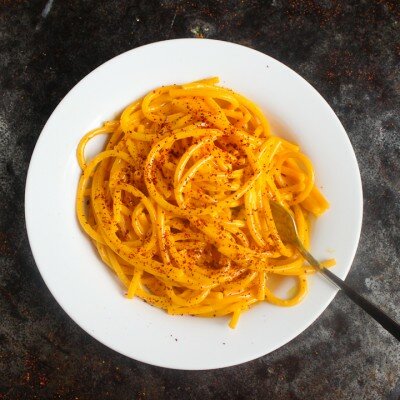
(NOTE: The instinct with this pasta is to toss it with some kind of seafood or chicken, but just because a dish has saffron doesn’t turn it into paella. I say honor the saffron. The chili flakes add a little balance.)
Pasta with Saffron Cream and Chili Flakes
Serves 4
2 shallots, minced
splash olive oil
½ cup or so white wine
generous pinch saffron
2 tablespoons butter
½ cup or so heavy cream
1 pound spaghetti
several pinches chili flakes
salt and pepper
- Heat a large pot of salted water over medium heat.
- Meanwhile, in a large sauté pan over medium heat, warm the oil, add the shallots and gently cook until soft but not browned.
- Add the wine, butter and saffron and simmer until reduced by half. Drop the pasta into the water to cook. Add the cream and simmer until reduced by at least half or until sauce consistency.
- Drain pasta, add to the saffron cream, season with chili flakes, salt, pepper, and serve.
The Ultimate Short Ribs
Sur La Table, a cooking store majoring in gadgets with a minor in
pots and pans. It’s like stepping out of a Vegas elevator right onto the casino floor. Past the entrance and just beyond the entrance and the shelves of pots, one enters a brightly lit world of smiles and, well, rubber: neon red whisks, lemon yellow basters, and food-coloring blue peelers. A riot of excess, the epicenter of kitchen fad-land, and the world’s whitest store.
Missing among the slew of reminders and timers, is something which nudges and jars your memory of dishes cooked and forgotten. Weeks ago I made a jar of Indian pickle with jalapenos: marinated overnight in spices (on the windowsill!?), cured in lemon juice overnight (same windowsill), then mixed with boiling sesame oil and left to sit for three days (windowsill) prior to refrigeration. (You have to sterilize the jars in a pot of boiling water before all this windowsill stuff.)
And so into the fridge sailed two jars of delicious homemade pickle, superior to any standard take out version and a condiment ready to adorn any variety of dishes. Two days ago, reaching for the ketchup, I glimpsed the lid of a gold Ball jar accompanied by the instant aromas of freshly sliced jalapenos and the sounds of drizzling rain as I stared for hours at the windowsill and the curing pickle.
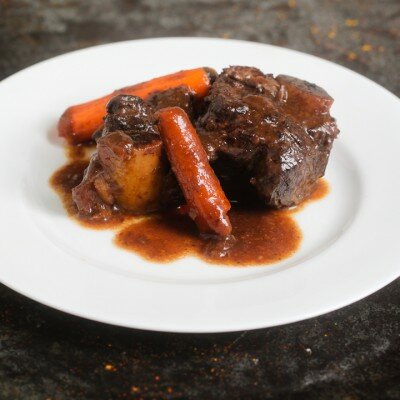
Sometimes you forget the food you cooked a mere two hours ago. For example, the classic wine-braised short ribs we simmered-till-melting Sunday at noon and re-discovered around dinnertime, soft-bubbling away in the oven. Being short ribs, that most forgiving of treats, they were extremely tasty, despite the slightly disorienting feeling of having a warm pot of stew magically appear in our oven, as if the tooth fairy or Santa himself had visited our apartment.
While loathe to suggest yet one more gadget to the folks at Sur La Table hq, here’s an idea: a retractable arm attached to the kitchen timer which, when the timer beeps, shoots out and smacks you in the head. There also might be a market for a similar item attached to a very long-term timer (“The Pickle Timer”), which can be suction-cupped to one’s windowsill.
The following is an unbelievably fantastic short rib recipe.
(NOTE: You don’t have to bind each short rib (of course), but it really does hold the thing together, which both makes it look better on the plate and eliminates the need to fish floating bones from the pot, possibly shredding meat in the process. Veal stock, frankly is critical here, unfortunately, but if you don’t have it, use boxed chicken stock and thicken with cornstarch. I’d be sad if you did that, however. Finally, good short ribs are hard to find; even Pino, our trusty butcher, gave us some lousy ones. They’re often scrawny, so don’t compromise and search out a good source for meaty ribs.)
Red Wine Braised Short Ribs (from Balthazar Cookbook)
Serves 4
5-6 pounds meaty short ribs (see NOTE)
few sprigs rosemary
few sprigs thyme
1 celery stalk halved crosswise
veg oil
4 carrots, peeled, cut in 1-inch lengths
1 onion, diced ½ inch
4 shallots, sliced ¼ inch
5 garlic cloves, halved
3 tablespoons tomato paste
3 tablespoons flour
½ cup ruby port
4 cubs red wine
4 cups veal stock
salt and pepper
- Preheat oven to 325.
- Tie butcher twine around each rib. Place herbs in between celery halves and tie in a bundle.
- Heat a splash of oil in a large pot over medium-high heat. Season ribs well with salt and pepper. Add to pot without crowding and brown well on all sides (about 5 minutes). Transfer to a large bowl and brown the next batch, add to same bowl.
- Pour off fat, add another splash of veg oil and add the carrots, onions, shallots and garlic, cooking until lightly browned. Season.
- Add tomato paste and stir in for a few minutes. Add port, wine, and celery, reduce by 1/3.
- Return ribs (hopefully in one layer). Season again, pour in stock to cover by 1 inch (add water if necessary). Bring to a simmer, cover, and place in oven for 3 hours.
- Transfer to a large platter, remove strings. Strain sauce and simmer down by half. Return ribs to pot and simmer 10 minutes. Serve. (We didn’t bother straining. An overdone carrot is a wonderful thing-just pick out the celery bundle).
Sunday Gravy
They say the “dining scene” in the city has never been stronger. The vibrancy of the eating scene, however, is less discussed and a bit shakier (by pop math, less discussed i.e. in the news = less important). One need only stand on the corner of 9th and 2nd to be convinced.
Veselka, which occupies this corner, is a Polish/Russian eatery and a longtime neighborhood staple. They serve pirogies and borscht and a long menu of similarly bland – borscht has yet to hit it big – Eastern European dishes. As tends to occur, ethnic neighborhoods shrink and shrink and shrink like a crummy shirt until (no pun)– the true sign of a dead end – they’re referred to as “pockets”. Veselka exists in one such pocket, a row of Polish bakeries and funeral homes and secret societies spreading a few blocks along 1st Avenue.
The bakeries and so on seem pretty genuine, or at least high on the dirty-brown-brick-angry-old-Polish-man scale, but Veselka looks and feels like a clean diner, such as one you might be happy to see by the side of a highway during a long family road trip. The clientele, however, is a cross-section of youngish downtowners and the NYU student showing the parents his favorite lunch spot.
Veselka the roadside diner only throws into relief the borough’s lost memories, as if someone jumped in with a giant eraser and wiped out pages and pages of urban history. When rootless, we often turn to food to find our way and these days chefs have dug up roots, but those from a little earlier than Veselka’s.
These cooks have descended pilgrim ships: farming and growing and carpentry and brining and pickling and cheese-making and vodka-making. Admirable activities all, but taking a cab to eat where some guy has spent the afternoon churning his own butter feels a bit disorienting. The more stuff he does from scratch, the weirder it feels, almost like a Polish grandma might feel on lower 2nd Ave. The following recipe brings us back to a just-right time and place.
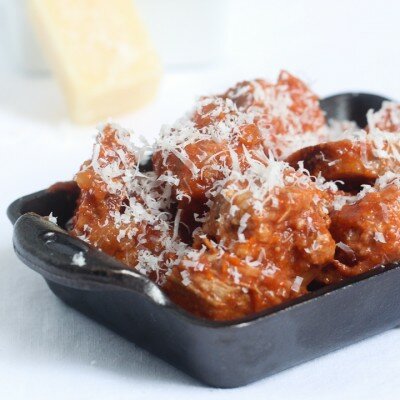
This meat-heavy “Sunday Gravy” recipe, from On Top of Spaghetti, is a staple pasta sauce over here. What I love about it is the rich variety of meats, which necessitates two bowls, one for sauced pasta, the other for the meat.
Sunday Gravy w/ Sausages and Meatballs (from On Top of Spaghetti)
Makes enough sauce for 6-8
¾ cup olive oil
3 center cut pork chops (about 1 ½ pounds)
1 ½ pounds Italian sausage
1 medium onion, diced
3 cloves garlic, chopped
3 ½ cups canned tomatoes
6oz tomato paste
rind from a piece of Parmesan
meatballs (below)
1 pound spaghetti
salt and pepper
Grated Parmesan
- Heat oil in a large pot and brown the meats. Remove to a bowl. Add onions and garlic and brown a bit. Season with salt and pepper and scrape bits from bottom of pot.
- Return meats to pot along with 4 cups water and everything but the meatballs and spaghetti. Bring to a boil, lower heat to simmer, cover and cook about an hour. Add meatballs and cook about 20 minutes.
- To serve, remove meats to a platter. Cook pasta, toss with sauce, and add to a second platter. Serve with grated cheese.
Meatballs
12 oz ground beef
4 slices crustless sandwich bread cut in cubes
¾ cup milk
1 cup grated pecorino
1 tablespoon minced parsley
1 egg, beaten
salt and pepper
1. Mix all ingredients. Chill in fridge for a bit. With wet hands roll into 1-inch balls.
Steakhouse Sides: Creamed Spinach

In sport, victory and defeat are measured by inches. If the ball hadn’t hit the crossbar, the puck sail a hair over the net, the finger slicing through the pool curl at the wall, the ball catch the wind just enough to miss the white line. It’s a matter of course worth the attention of any diligent steak house chef.
Until say, the 1970s, the steakhouse chef was a revered fellow on the culinary scene. A steak and perhaps half a broiled lobster sat atop the food world, symbolizing luxury and skill. But, as with cars and computers, we improve, or at least vary stuff, hence the contemporary menu. Left behind is the guy who can cook a good piece of meat, but-at least in the general mindset-little else. He’s befuddled by a bunch of kale, a bucket of sweetbreads, or even a packet of yeast.

Lost in the shuffle is respect for execution. I’d rather have a perfect steak than a crummy kale salad, for instance. And the chef who can execute excellent sides (for me, the decisive mark of quality) is someone who can cook anywhere. The prime offenses: stringy creamed spinach or a plate of barely browned, diced potatoes labeled hash browns. The former should be smooth and properly seasoned, the latter a crisp cake whose potato interior is light and buttery and steaming hot.
Once you master the sides, you don’t even need the steak. Or you can cook it for hash the next day, also kind of a side. Until eventually you become an eater of primarily side dishes and turn into a side dish snob and never enter another steakhouse. And sit at home in your jammies eating homemade creamed spinach and hash. Today’s post: creamed spinach.
(NOTE: To gratinate this sucker lay several slices of gruyere over the top and broil.)
Creamed Spinach (via food.com)
yield: 4
2 (10oz) bags spinach
6 tablespoons unsalted butter
¼ cup flour
¼ cup minced onion
1 bay leaf
1 clove
2 cups milk
salt and pepper
- Cook spinach in boiling water a few minutes till wilted, drain under cold water in a colander, squeeze out as much moisture as possible, chop coarsely, transfer to a food processor and process to a slightly chunky puree. Reserve.
- Melt half the butter in medium saucepan over medium heat.
- Add flour, stir till golden, about 7 minutes.
- Stir in onion, bay leaf, and clove, whisk in milk, simmer till thickens, about 10 minutes, reduce heat to low, cook a few more minutes, whisking.
- Add spinach to warm sauce, simmer a few minutes, stir in remaining butter, season and serve.
Lahore Chicken and Potato Curry

Sometimes you have to know the bad to achieve the good. To wit, a variety of dictators and inky newsprint, and for our purpose, lousy curries.
You easily can grab the wrong Indian takeout menu and end up with a quart of protein morsels floating in greasy sauce reminiscent of the hot line at a Korean deli. The line between good and bad Indian food is hardly razor thin: the place near us in Tribeca is great; the one a few blocks down is terrible. It’s a pattern as reliable as the cycles of the orbs..
From my experience, the finest Indian food is that produced inside an Indian household. However, I’m a great believer that Indian food is well-suited to any home.
The critical step one is a pantry; raid a good Indian grocery and overpurchase: bags of cardamom, cloves, dals, jasmine rice, cinnamon sticks, fenugreek, asoefatida, garam masala, coriander, cumin, curry, mustard oil, mustard seeds, unsweetened coconut, curry leaves, fresh and dried chilies, ghee, jaggery, tamarind extract or blocks, and any powders you may or may never need. It becomes an addiction, but you can hooked on far worse. Unless you start going on regular Kingfisher and betel leaf binges.
Once you possess the tools, you can cook anything. Because these mostly quick preparations make for easy weekday meals, you’ll gain a pretty deft hand in no time, your fingers acquainting themselves to the feel of a pinch of this and a pinch of that, your ears attuning to the pop of mustard seeds, your instincts developing a comfortable sense of timing and how to work with your newly minted pantry.
In the manner of Indian home cooks, we like to keep the curries simple, healthy chunks of a few vegetables or meats touched with spice and, if called for, an appropriate amount of sauce. Here we made one with chicken and potatoes, but as with a good movie script, the star of the show isn’t the chicken or the veg, but the foundation, your stocked and fragrant pantry.
(NOTE: pay attention to the salt-it’ll need assertive seasoning. Also, don’t be fooled by the chicken, the potatoes may take a bit longer to cook. I’d rather have slightly dry chicken breast (it’s in a flavorful sauce anyhow) and tender potatoes than perfect chicken and undercooked veg.)
Lahori Chicken with Whole Spices and Potatoes (from Suvir Saran’s GREAT book Indian Home Cooking)
Serves 4
2 ½ pounds chicken breasts and thighs, skinless (or a large whole cut up bird), in 1-inch chunks
3 large red potatoes, peeled, quartered
¾ teaspoon turmeric
½ teaspoon cayenne
salt
1 ½ medium onions rough dice
5 garlic cloves
2 inch piece ginger peeled, halved
3 tablespoons canola
1 inch piece cinnamon stick
12 green cardamom pods
9 cloves
10 black peppercorns
3 whole red dried chiles
1 teaspoon coriander seeds
½ teaspoon cumin seeds
1 fresh hot chile, halved
2 large tomatoes, chopped
2 tablespoons tomato paste
¼ cup plain yogurt, whisked
1 cup water
½ cup chopped cilantro
juice 1 lemon
- Combine chicken, taters, turmeric, ¼ teaspoon of cayenne, pinch of salt and marinate in a bowl.
- Puree onions, ginger, garlic in a food processor and set aside.
- Heat oil with the spices (cinnamon stick to cumin in the ingr list) in a medium pot over medium high heat. When cinnamon unfurls, 1-2 inutes, add onion mixture, chile, and a pinch of salt, cook, stirring till veggies brown, about 8-10 minutes.
- Remove cinnamon and chile (we kept in the chile for heat), stir in remaining turmeric and cayenne. Add tomatoes and tomato paste, stir 5 minutes. Puree in blender or processor until smooth.
- Heat remaining oil in the pot, add chicken and taters, cook stirring 2 minutes to thicken a bit.
- Add pureed tomato mixture, bring to a boil, stir in water, return to a boil, reduce heat and partially cover, simmer about 30 minutes until the chicken is cooked through and the taters are tender. Stir ever few minutes to prevent sauce sticking. Uncover, reduce to thicken, stir in cilantro, lemon juice and season with salt if necessary (SEE NOTE).
Braised and Fried Lamb Shoulder

The darkest area of a blacked out city is one’s stairwell. And so when Sandy hit, I nearly broke my neck navigating my way down to the first floor. But we landed safely in a powered-up section of the ‘burbs for a 4-day encampment.
I rarely find myself in a super-sized grocery store. New York lacks the necessary real estate. But when a storm upends an enormous city, you find yourself in strange places. Like the meat dept. of a giant Stop & Shop.
Precisely portioned, wrapped, and useful, the meat could be dried beans, ketchup, or paper towels. From a naturalist’s viewpoint, it may be worth a field visit: where else is cow like a chicken and a chicken like a pig? It reminds me of my brief stint in a restaurant where the salad guy applied his dressings by color. The mega-mart should organize the meat similarly: red here, white there.

This is meat ready to assemble like a child’s toy: take home and inject with enough heat to make it safe and edible.
We’re lucky to have an honest to goodness butcher in the neighborhood. Not a Chelsea Market or Brooklyn hipster butcher sprung from the pages of the Times Dining section and food tv. Rather, Pino has been manning his sawdusty shop on Sullivan Street forever, in a postage-stamp sized corner of Soho not yet snatched up by clothing stores.
Most of the time, Pino hauls out half an animal from the fridge and lops off whatever I want or he suggests. (Usually, no pricier than superstore meat mind you.) As opposed to superstore meat, which parachutes from the sky, stuff from a good butcher is on a meandering journey, with pauses along the way to smell the coffee, the finish line being the kitchen table.
You unfold the butcher paper and consider the flesh. A high-quality burger or a slab of liver are headed for a hot, oiled pan, as would a homemade sausage or hangar steak. You may have picked up some pork belly or shoulder for braising or roasting. We decided the other day on two sections with which I rarely cook: lamb shoulder and lamb belly.
We braised, shredded, and fried the meat for a tasty lamb taco. I’d rather have an elevator than a butcher, but in case this all sounds snobbish, I’d rather have a butcher than a wine store.
Braised Lamb Shoulder
(serves 4-6)
2 bone-in lamb shoulders
olive oil
a few Spanish onions, peeled and cut in eighths
6 plum tomatoes, seeded, chopped
a few sliced chilies
5 sprigs rosemary
½ cup Madeira
½ cup port
1 cup fresh orange juice
2 cups chicken stock
1 head garlic, halved widthwise
salt and pepper
- Preheat oven to 375. Season lamb well, heat oil in a large sauté pan and brown the shoulders all over. Remove to a large roasting pan.
- Add onions to the pan and fry until lightly browned, then add tomatoes, chili and 3 of the rosemary sprigs. Stir and add alcohol. Bring to a boil, reduce a bit, pour over lamb. Pour orange juice and stock over the lamb. Cover loosely with parchment paper, transfer to oven and braise until the meat shrinks from the bone, about 1 ½ hours.
- Remove lamb, let cool completely in pan, lift from pan and refrigerate an hour or more. Strain the liquid into a pot and reserve vegetables.
- Boil juices to a saucelike consistency, add the veg and keep warm. Remove lamb, slice shoulder in large pieces and fry in a large pan with olive oil, the halved garlic and remaining 2 rosemary sprigs until browned and crisp. Serve with the sauce.