Intro to a duck a l’orange recipe, source to be named later:
“This classic dish displays all the talents of the saucier, a position normally reserved for the most qualified cook in the kitchen. Duck a l’orange brings out his talents to combine three distinctly different flavors.”
Given the dish (dated) and the pedantic tone, you’d think perhaps Escoffier or a cooking school textbook (I know it sounds like ours, with its soufflé and mousse addiction). But it’s from the Balthazar cookbook, one of our favorites, for its food clear directions, and structure, but moreso its honesty: the dishes seem simple but spring from years of toil, a fact which, despite the seeming simplicity of the recipes, comes through loud and clear.
Like the Federer forehand, the Balthazar book embodies one of my favorite sayings: “he makes it looks easy”. It’s a good measure of excellence; if something looks like a breeze, it’s probably exactly the opposite. Of course, it goes around and around: what looks easy should be easy and thus generally doable.
But it’s not, which is where the obnoxious American enters the picture. The football fan screaming at that bastard who “somehow” fails to catch a badly overthrown ball. The superhuman leap, which leaves the player’s knees hanging in the air ready to be torn off by an angry giant, is forgotten. Or the restaurant critic reaming a chef who fails to produce a perfect plate of food; the dance critic wondering how a ballerina could have slipped.
The unfortunate reality is that excellence is the result of hard work. In this respect, good cooking is deceptive: tasty dishes with a limited ingredient list, are often the product of more blood sweat and tears than something molded, stuffed, wrapped, braised, sautéed, chilled, sliced, and glazed with aspic.
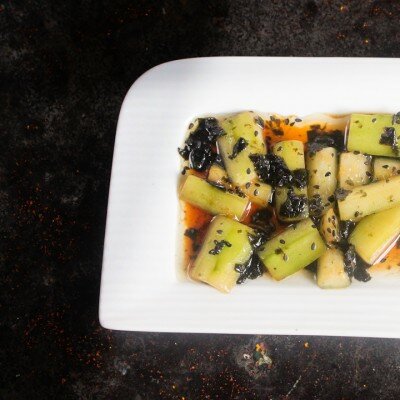
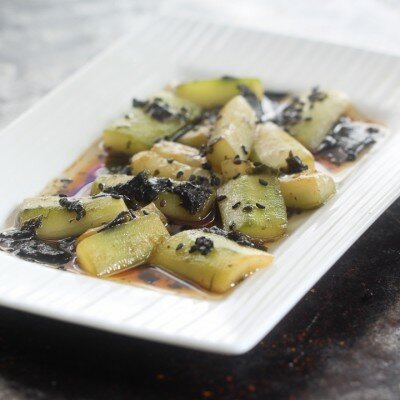
The sauce in this recipe is really good; it pairs perfectly with a quick cucumber sauté. We got it from, the Japanese chef Tetsuya Wakuda, who spoons the stuff over rare salmon. It’s a simple mixture, or should I say, he makes it look simple, which is high praise indeed.
Warm Cucumber With Nori Dressing
Serves 4 as a side dish
2 seedless cucumbers
1 sheet nori crumbled into small flakes
1 ½ tablespoons soy
2 tablespoons mirin
¼ cup rice vinegar
1 tablespoon sesame oil
1 teaspoon sugar
¼ cup olive oil plus 2 tablespoons
pinch salt
1 tablespoon black sesame seeds
- Peel and halve the cukes lengthwise. Remove seeds with a spoon. Slice halves widthwise in 1 inch pieces then cut the sections in half to form pieces about 1 by ¼ inch. Reserve in a bowl.
- Make the dressing: in a medium bowl, whisk the ingredients together except for the nori and the 2 tablespoons olive oil. Stir in the crumbled nori. Let sit ½ hour.
- Heat the two tablespoons oil in a large sauté pan over medium high heat. When hazy, add the cucumbers and saute, stirring occasionally, for about 2 minutes or until warmed through and tender but not overcooked. They should have a bit of a bite.
- Pour the warm cucumbers into the bowl with the dressing, toss, and serve on a platter.