Subscribe to The Dish
Lunch
SUB! Serrano Ham, Manchego, Grated Tomato

About five years ago, I discovered the perfect sub. Sandwich, that is, not the submersible propeller kind. At White House Sub Shop in Atlantic City, it was equivalent to Supper’s caci e pepe being your inaugural bowl of pasta. White House is one of the last legitimate eateries left in Atlantic City, and it’s worth the trip, but bring your track shoes-you may need to dodge bullets on the way in and the way out.
As Caroline Russock at Serious Eats noted, the key to the White House sandwich is the hot chile pepper condiment spooned over the meat. The bread is also superb: fresh, slightly crusty, and not too dense. I also like the sheer size: a full sub is a two foot-long torpedo wrapped in butcher paper. All day people stream out, balancing sacks of them as they sprint to the car. (Bring the shoes.)
While the White House makes a fantastic sandwich, it is summer after all, and with high quality ingredients you can put together a lighter, equally delicious sub. Rather than the papery, bland shrink-wrapped prosciutto from the supermarket, we used a delicious, salty, porky, dry Serrano ham from D’Espana. While there we snatched up some manchego; on the way home we grabbed a few good rolls and tomatoes from a Little Italy market.
The condiment here is a take on tomato bread, a tapas staple (to stay with the Spanish theme of the day) in which a tomato is halved and grated onto crostini. Since we were composing a sandwich, a heartier, more liquid version was called for, so we grated the flesh into a bowl and spooned it over the bread.
As with anything in life, this sandwich is a trade-off: unless you live conveniently near a bunch of great specialty stores, finding first-rate ingredients may be a bit of a hunt. On the other hand, you won’t have to trek to A.C. and risk your life. If you’re within say, 50 miles of the shore, however, I do recommend the White House Sub.
(NOTE: the nectarine adds sweetness (obviously), though you can omit if you don’t want that gourmet stuff. It is nectarine season, though, so might as well go for it now when you can.)
Serrano Ham and Manchego Sub w/ Grated Tomato
Makes 4
1 beefsteak tomato
6 tablespoons olive oil
2 tablespoons sherry vinegar
10 oz sliced Serrano ham
10 oz sliced manchego
1 nectarine (optional)
4 ciabatta rolls
salt and pepper
- Halve the tomato. Cut side facing the grater, grate the flesh of both halves into a medium bowl. Season with salt and pepper, two tablespoons of the olive oil and the vinegar. Set aside.
- Split the rolls and toast very lightly, until barely colored. Remove and spoon several tablespoons of grated tomato on one side. Top with the ham, cheese and optional nectarines. Serve.
Shrimp Salad w/ Green Peppercorns

We spend August in Truro. Truro is way out on the Cape, nearly as far as you can go, just before Provincetown, the tip of the curl, a place you’d think remote, yet jammed with schlocky shops and summer beachgoers strolling its narrow streets day and night.
No matter. The farther out on the Cape, the more you realize it’s truly a fishing zone. Markets sell giant, thick hunks of swordfish, tuna, and bass, as well as crab and buckets of steamers ready to be cleaned and dunked in clarified butter.
The long drive to this seafood mecca necessitates a roadside diner stop. Last year, either we chose the wrong place, or pureed chicken salad is a tradition among these joints. Needless to say, my mushy scoop went untouched.
“Protein salad”, for lack of a better term, shouldn’t be mushy. (By “protein” I mean chicken, tuna, egg, etc. It must be a remnant of my days working at the cooking school receiving dock where every morning the “protein” guy unloaded the truck, handing over the meat and fish for us to label and cart up to the classes where students would destroy the helpless aforementioned “protein”.)
While I like my “protein” salad at least semi-chunky, it’s tricky to achieve success. Chunks of chicken or, in this case, shrimp, don’t bind well with mayo, a failing perfect for a salad, less perfect for a sandwich. Sandwiches, you see, shouldn’t collapse with one bite. The filling has to remain inside the bread, otherwise you’re left with soggy bread and a handful of whatever.
A handful of bite-sized shrimp tossed with a few herbs makes for a great salad as well as a tasty sandwich.if matched with the right bread. It should be a soft bread (see mayo-less lobster roll): the violent wrestling motion inspired by a crusty roll or baguette causes spillage. Go light on the mayo to prevent soaking, but if need be, use a few leaves of protective romaine.
If you make it to the Cape, you may as well soldier on to the end and taste the purest seafood on the East Coast. Alternatively, a good shrimp salad is a good simulation.
(NOTE: We made an hors d’oeuvre, which works well. You can even use crusty bread, as it’s only a one or two biter. Adjust the seasonings to taste.)
Shrimp Salad Canape
Makes 8
1/2 pound peeled, deveined shrimp (or do it yourself, it’s cheaper)
¼ cup mayo
1 tablespoon dijon
1 teaspoon green peppercorns
2 tablespoons capers
1 tablespoon tarragon, minced
1/3 cup celery, small dice
3 tablespoons scallions, thinly sliced
1 baguette, ½ inch slice
salt and pepper
1. Bring a large pot of water to a boil. Add the shrimp and blanch 5 minutes. Drain, cool under running cold water or an ice bath. Dry well.
2. Chop shrimp into ½ inch pieces and reserve.
3. In a medium bowl whisk together the mayo and Dijon. Fold in the shrimp then the rest of the ingredients. Refrigerate.
4. Spoon salad on bread and serve. Alternatively, serve in a nice bowl alongside the bread and dig in
Yogurt Rice, or the importance of curry leaves

I can’t decide whether Paul Bertolli’s book, Cooking By Hand, is obnoxious, critical culinary instruction, or a bit of both. Bertolli, longtime Chez Panisse chef, is known for his exacting dissection of ingredients. Minutiae are his thing: percentages of hard to soft wheat in flours for fresh pasta; the advantages of milling your own wheat for the same; the crucial distinctions between balsamic vinegars, heritage pork breeds, and so on.
Is he on target? Is it really pointless to make fresh flat noodles out of Baker’s Choice versus the little known but ideal Promotory brand, constructed from a “harder” wheat? If he came to dinner and I served him Baker’s Choice pasta would he toss it out the window onto the Broadway pavement below?
I suppose a massive series of taste tests would put the matter to rest, but that’s one kitchen project I doubt we’ll undertake. It’s messy enough to make one batch of fresh pasta. Pushing out a second batch using special mail-order flour and mineral water would surely coat the apartment with a thick, floury mat. Also, logistics aren’t in my favor: It’s tough to hang sausages in a New York City apartment and even trickier to find the space for a flour mill.
I will concede, however, that there is such a thing as an indispensable ingredient without which a dish is a mere shadow of the genuine article. For certain dishes, “optional”, a term which peppers so many recipes, is at best wishy-washy and at worst criminal. Curry leaves are just such an ingredient.
Living in New York, we’re spoiled by the profusion of specialty items. For most, a lush garden of unusual stuff is a few subway stops, or brief traffic dodging bike ride away. And so I cycle uptown, wearing my empty backpack, past Union Square, into Gramercy, to Kalustyan’s from which I emerge, backpack stuffed with sacks of dals, pink salt, bags of spices, nuts, and, invariably, the aforementioned fresh curry leaves. The ride back is slightly more perilous.
Earthy and almost toasty, fresh curry leaves are a critical component of Indian cooking. Imagine fried chicken without salt, a burger without ketchup, or chicken salad without celery, and you get the idea. Curry leaves round out the dish, adding fragrance, flavor, and color to an otherwise lifeless product.
Yogurt rice is a perfect example. Yogurt rice is a delicious, cold side dish of Basmati rice mixed with yogurt, fried dal, mustard seeds, chiles, and curry leaves. It is Indian food at its purest: quick with an exquisite balance of spices. Minus a handful of curry leaves, yogurt rice is forgettable and frankly not worth the trouble.
Paul Bertolli may know everything about pasta, balsamic vinegar, and sausages, but he can’t convince me I won’t be able to follow his tortelli of tagliatelle with braised poussin recipe and come out with a pretty decent dish of pasta. However, I know for sure that if you come across an Indian recipe which calls for “optional” curry leaves, and you don’t have any, make something else. It simply won’t be the same.
(NOTE: you can use all urad dal or mung dal. Asafoetida is highly useful in Indian cooking, and in the spirit of this post I haven’t labeled it “optional”, but if you can’t find the stuff I won’t be too upset.)
Yogurt Rice
Serves 4
1 cup basmati rice
2 tablespoons olive oil
½ teaspoon mustard seeds
12 curry leaves
3 dried chiles
2 tablespoons urad dal
2 tablespoons chana dal
¼ teaspoon turmeric
pinch asafoetida
2 cups yogurt
juice ½ lemon
- Wash rice. Combine with 2 cups water in a medium saucepan, bring to a boil, stir, cover, simmer slowly until done, then leave 15 minutes before fluffing.
- Heat oil in a small pan with the mustard seeds. When they begin to pop, add the curry leaves, chiles, and dal. Fry, stirring, about 2 minutes, till the dal has colored. Stir in turmeric and asafetida.
- Combine the yogurt and dal mixture in a large bowl, mix in rice, season with salt and lemon juice. Refrigerate. Serve cold.
Seared Tuna Sandwich w/ Tzatziki

Most people seem to like tuna salad sandwiches. I don’t, but I have a few theories.
One: it’s purely a vehicle for mayo. Two: it’s pretty cheap. Three: it’s easy to make. Four: it’s a social mandate. Five: people like canned tuna.
As to these points:
-Any vehicle for mayo is okay by me. Caesar’s salad comes to mind. However, the underlying ingredient has to have at least a modicum of merit, which, to my mind, tuna does not have. (see #5)
-Tuna is relatively cheap, and thus makes for a pretty reasonable lunch. But so is peanut butter and jelly. Or cheese. Or soup. Or water, which I’d eat/drink before I’d have a tuna sandwich.
-It is easy to make. Can’t deny that.
-Tuna salad does seem genetically inbred from the time we first pack a lunchbox and head to school.
-Canned tuna is a real problem. For one, fish was never meant to be packed into a tiny can. Also, the rule on fresh tuna is it dries out easily if overcooked. And yet, canned tuna is dry as a desert, a violation of the above standard. Hence the NEED for mayo, without which you’ve got a desiccated hockey puck unfit for consumption. (Again, in my view.) A vehicle for mayo is no problem. A NEED for mayo is a different issue. What’s that you say? Romaine needs dressing too? Yeah, but I’d rather eat a bowl of plain romaine. Finally, tuna smells awfully fishy, the not too surprising result of trapping fish in a tiny can.
A chicken salad sandwich is a different story. Chicken is neither fishy nor stringy, and it can be shredded, sliced, cubed, etc. and turned into a great, clean, toothsome, unstringy product.
Now fresh tuna makes a fantastic sandwich. It’s rare, silky interior ensures easy eating; it’s lean, healthy, and a great way to increase your fish intake, and it’s flavorful yet also sort of a blank slate able to pair with any number of condiments and other sandwich accoutrements.
The downside of course, is the expense. To that I have no snappy answer except to say splurge if you can. If you can’t, please, please eat chicken salad.
Seared Tuna Sandwich
Makes 4 sandwiches
2 cups strained Greek yogurt
1 large cucumber, grated
1 clove garlic, minced
1 ¼ pounds fresh tuna
2 tablespoons olive oil
1 head romaine
I baguette
salt and pepper
- Add the yogurt to a medium bowl and fold in the cucumber and garlic. Season with salt and pepper. Refrigerate.
- Season the tuna on both sides. Heat the oil in a medium pan over medium high heat until nearly smoking. Gently slip in the tuna and sear until browned, about 1 ½ minutes. Flip and cook the second side. About 3 minutes total. Remove to a cutting board.
- Slice the baguette lengthwise. (Or first cut in 4 even pieces then slice if too awkward.)
- Slice the tuna thinly, about ¼ inch. Spread the baguette with the yogurt, lay over the romaine, shingle the tuna evenly over the lettuce, slice and serve.
Crab Cakes Done Right

I don’t believe in that firm stance of refusing to order an item in a restaurant which you could make at home. Restaurants are about luxury; people bring stuff to you. They refill your water glass; cook your food; play music over the speaker; say hi and goodbye. Whether or not you could make it at home isn’t really the issue. Usually.
But they still need you to return, hence easy-listening menu options such as burgers and fries, steak, salmon (a friendly fish), pasta, and so on. All of which can be very tasty. Crab cakes, though, are a curiously ubiquitous offering.
The genesis of the crab cake is a mystery. At its best-purely crab, very lightly breaded-it’s still a hockey puck served with dressing on the side. Because it’s so popular, you’d think McDonald’s would have coopted the crab cake. However, crab is prohibitively costly, which is why, in addition to being fried, it’s a restaurant favorite.
Expensive and plain, crab cakes, to my view, are, yes, best made at home. Not because in your kitchen they’re any less plain, but for another key reason: the bowl. The best part of crab cakes is stealing a spoonful of newly-mixed fresh crab. The lump crab, tossed with a light dressing of mayo, capers, cayenne, and herbs, is delicious, especially in summer. Why not just make a salad of it, you may ask. You can, though here it’s like eating cake batter, where half the fun is the anticipation.
And, to be fair, a good crab cake is worth the anticipation: crisp and sweet assisted by a rich, astringent dressing. It’s just not something, despite a restaurant’s inherent luxury, I’d order.
(NOTE: I was feeling in a diet mood so I bypassed pan-frying and opted for the oven, which worked well. Also, these guys serve it as a sandwich on brioche with their Cajun Remoulade, which is probably pretty tasty, but I made my own yogurt dressing-see below.)
Crab Cakes (adapted from Clinton St. Baking Cookbook)
Serves 4
1 egg, beaten
1 tablespoon fresh lemon juice
¾ cup fresh white breadcrumbs
1 tablespoon chopped parsley
1 tablespoon chopped capers
1 tablespoon minced onion
¼ cup Hellman’s mayo
1 teaspoon Dijon mustard
pinch cayenne
1 teaspoon salt
¼ teaspoon white or black pepper
1 pound lump crabmeat
2 teaspoons Canola
- Preheat oven to 350.
- Mix egg, lemon juice, ½ cup of the breadcrumbs, parsley, capers and onion with the mayo, mustard, and seasonings. Fold in crabmeat and shape 4-5 ounce cakes with your hands. Dredge in remaining breadrumbs.
- Refrigerate cakes for an hour then place on a oiled tray and into oven until lightly browned. Turn off the oven, switch to the broiler, place on a rack close to the broiler and sear until fairly dark and crunchy, flipping once. Serve with the sauce.
Yogurt Dressing
1 cup strained 2% Greek yogurt
2 tablespoons chopped capers
2 tablespoon chopped tarragon
2 tablespoons minced garlic
2 tablespoons chopped chives
salt and pepper
1. Fold all ingredients together, season well with salt and pepper. Refrigerate till ready to serve.
Upma-The Art of Spice

There’s okra and there’s okra. I haven’t done a formal survey, but it’s a fair bet a lot of people don’t like the stuff. It’s cool-looking-a green, faceted pod-but tough to cook. You can’t eat it raw, and, heated, it releases a strange sticky white gel. Sound gross? Not at all. The entire thing-nutty, crunchy seeds and toothsome skin-is edible and even hearty, a rare quality in a green vegetable.
That is, if you cook it right, i.e. nicely browned and al dente. If you screw it up you get that plateful of nasty vegetal ooze, which scares, off cook and diner alike.
To my mind, Indian cooks have truly mastered okra. They slice it in small chunks and give it a quick toss in a hot pan with plenty of spices. Not only does the vegetable retain its integrity, but the spice heightens the flavor. It’s what I love about Indian cooking: respect for the ingredient paired with respect for the spice.

Tamarind, a few blocks from us, is a fantastic Indian place. A giant, airy two-level loft, it attracts a sharp-dressed crowd. A far cry from the neighborhood Indian place of my childhood, with its oppressive red velvet walls, neon-red tandoori chicken, and soul-deadening sitar music, Tamarind is an Indian restaurant for the modern era.
The spice pantry at Tamarind must be cavernous, and most of it seems to go into the okra, a mixture of okra, ginger, and a wild handful of ground and whole spice. Whole spice is among the best elements of this cooking: the seeds add crunch and a strong but not overwhelming flavor, which is muted by hot oil.

Upma, introduced to me years ago, is the quintessential whole-spice Indian dish. Like the best quick curries-okra, eggplant, or other-it’s a mix of a simple ingredient and complex spice. Although fortified with potatoes and tomatoes, the main ingredient couldn’t be more basic-cream of wheat-making upma essentially a dish as suited to breakfast as it is lunch or dinner.
Lending a great crunch to the otherwise soupy cream of wheat, the whole seeds make upma a great starting point for anyone interested in cooking Indian food. It’s like sinking into a bubble bath: the warm water is great, but nothing without the bubbles.
Upma
Serves 4
¼ cup olive oil (or canola)
3 tablespoons toor dal (or any small-sized dal, i.e. not chana)
2 tablespoons cumin seed
2 tablespoons mustard seeds (black, preferably)
2 yukon gold or red bliss potatoes, peeled in 1-inch chunks
3 plum tomatoes in chunks
1 inch ginger, peeled and minced
1 cup cream of wheat
salt
3-4 small red chiles, chopped thinly, with seeds (if you can deal with the heat)
- Add the oil and spices to a medium pot over medium heat. When the mustard seeds pop and the dal starts to color (about 30-40 seconds), add the ginger, potatoes, and tomatoes.
- Cook a few minutes, stirring, and season with salt. Not too heavily-this is just the first seasoning-you don’t want the final product to be too salty. Adjust at the end.
- (This is where we go off recipe a bit.) Add enough water as you want-it’ll determine how much upma you want. For this amount of spice and other ingredients, I add quite a bit-enough to cover the veg by probably 2 inches.
- Raise the heat a bit and bring to boil. Stirring constantly with a wooden spoon, add the cream of wheat in a thin, slow stream. You don’t want lumps.
- Reduce to low heat and cook, stirring, until the upma thickens. You don’t want cement, rather, a smooth, thin porridge. Season again with plenty of salt. If you’re being fancy, plate it and garnish with chiles. Otherwise, just stir em in. Serve hot. (But it’s great cold the next day.)
Artichoke Confit

If you want to encourage a non-cook to use his kitchen, the artichoke is not a great place to start. The majority of this globe is inedible, woody fiber. Getting to the “food” is like hacking through the Amazon with a machete: tough, army-green plant matter flying all around, settling, finally, on your kitchen floor.
Other poor starter foods may include: unpitted olives, beets, leeks, fennel, and mangoes. These are fruits and vegetables that inspire a special kind of listlessness. No one wants to go home and have a death match with the Thomas train you bought for your kid, and which requires a surgeon’s touch to install the batteries. So why take home produce that seems equally labor-intensive and annoying? Which is one reason why markets sell more cucumbers and lettuce than fennel.
Unfortunately, nature doesn’t accommodate the produce shopper, who misses out by passing on items such as fennel and artichokes. In his photographs, Charles Jones, the late 19th century gardener and photographer, captured the complexities of these vegetables. Their odd structure-curves and crevasses, folds, points, humps, and waves-requires a little finesse with the knife.
There is a labor factor hierarchy here. An olive pit is an annoying little nub. Beets (unless shaved very thin) require long cooking. Leeks come embedded with grit, and fennel has a difficult structure to make sense of.
Artichokes, however, conjure the most terror in home kitchens. Rather than a vegetable, they seem an object to conquer, a beast of prey genetically designed to withhold its treasure.
There is a quick way and a relatively slow way to extract the heart of the choke. The quick is really a restaurant method mastered by practicing on crates of chokes under the whip of a sadistic chef. There are more peaceful systems, and this is my preferred method:
- Squeeze a bunch of lemons into a bowl of cold water. Drop in the squeezed halves.
- With your hand, rotate the artichoke and snap off most of the bottom third of the leaves. Make sure not to pull down, as that will tear off edible choke. When you hit the light green layer, use a super sharp or serrated knife and slice just above it (about a third of the way from the bottom of the choke). Discard everything but what you’re holding (choke and stem)
- Using a paring knife and/or peeler, trim off the remaining green parts. Peel the stem as well.
- Using a spoon, scrape out the fibrous choke. Drop into the acidulated water.
Step-by-step photos would be easier perhaps, but this isn’t a glossy food mag. If I haven’t explained it well, email or consult the web. I prefer this method.
As for cooking, you can do pretty much anything: sauté, roast, add to a braise, steam, parcook and add to pasta, etc.
While these are all fine, to bring out the essence, the pure artichoke flavor, I prefer to confit in a few cups of olive oil. Unlike cooking in a liquid medium, none of the flavor is leached out, and unlike sautéing or roasting, there is no caramelization, which alters the taste.
Gently poaching in olive oil gives you a creamy, unadulterated artichoke. And after all that work, you may as well enjoy the real thing.
(Note: For this recipe, pureeing the already creamy flesh with the cooking oil makes for a luscious product. Topping it with the tender confited leaves adds flavor and texture. Be sure to use only the bright yellow leaves! Even slightly green leaves turn into chewing tobacco. Save the remaining oil for a vinaigrette.)
Artichoke Puree w/ Tender Artichoke Leaves
Serves 2
1 globe (large) artichoke, quartered, yellow inner leaves reserved
2 lemons, halved
2-3 cups olive oil
1 clove garlic, minced
¼ cup parmesan, grated
salt and pepper
- Prepare the artichoke as described above and reserve in the lemon water.
- Drain and dry. Add the quartered heart (you can cut in large chunks) and the leaves to a small pot and pour in the oil just to cover. Place under low heat and cook until very tender. You may need more oil than called for. Also, be sure not to let it bubble too much. You want a very low simmer. Remove from heat.
- Using a slotted spoon, remove the choke (not the leaves) to a blender along with the garlic and parmesan. Turn on blender and puree, adding enough of the flavored oil to achieve a very smooth texture. Season with salt and pepper.
- Plate the puree, sprinkling with the confited leaves.
Meatloaf Sandwich-the best meatloaf

With a few exceptions-spicy waffle fries, chickwiches, tater tots, come to mind-I have a rule never to eat or cook anything served in my high school/college cafeteria.
As to the exceptions: frozen, then fried food are often pretty good. Or maybe it was the sheer luxury of being offered tater tots and cereal all in the same place. Enter the kitchen, load up on tots and make your way to the cereal barrels where you confront a marvelous array of options.
Cafeteria food is problematic in a few ways. Large, steam-heated pans of food are off-putting, suggestive of sweaty guys stirring cauldrons and prying open industrial steel cans.
The presentation is nearly as troublesome. Most often, the art of disguise is the driving strategy, the true test of a skilled cafeteria chef. Which explains the prevalence of Shepherd’s Pie, a truly deceitful dish: a few inches of firm mashed potatoes draped over a pile of meat. I’ll take a hot plate of short ribs sinking into silken potato puree over even the most skilled Shepherd’s Pie, if only because I like to see what I’m about to eat.
Drenched in gluey, off-brown gravy (see any Asian offering), meatloaf is sadly, also disguised. I say sadly, because meatloaf is the ultimate naked creation. You can’t, and shouldn’t have to, hide what it is, namely a meat football. As such, it’s a challenging dish to make correctly, but the right recipe yields a slice of well-seasoned, moist, meat whose flavor deepens the following day.
From bread to filling, sandwiches depend on quality ingredients, which is why great meatloaf makes for a great sandwich. Because meatloaf requires a sensitive balance of meat and spice, I’d recommend finding a quality recipe and sticking to it.
The Silver Palate version is as good as it gets: sausage and half and half contribute moisture as well as fat. We cheated a bit, tossing in a dry-aged, fatty burger from Pino the butcher.
I’d mass mail this recipe to my old schools, but only through years of dry, gloppy meatloaf will the kids seek out a better option, and that’s what learning’s all about.
(Note: I couldn’t find a pan large enough to accommodate a loaf the size called for, and of course, neither could I dig up one large enough to accommodate the meatloaf pan. Hence, I made a thicker football –about 12-14 inches long-which naturally takes longer to cook-about 1 or more hours. Use a meat thermometer. For a sandwich, follow step 8.)
Meatloaf (from The New Basics Cookbook)
Serves 8-10
3 tablespoons unsalted butter
¾ cup onions, minced
¾ cup scallions, minced
½ cup carrots, minced
¼ cup celery, minced
¼ cup red pepper, minced
¼ cup green pepper, minced
2 teaspoons minced garlic
¼ teaspoon cayenne
1 teaspoon ground cumin
1/2 teaspoon freshly greated nutmeg
3 eggs, beaten
½ cup ketchup
½ cup half and half
2 pounds ground beef (chuck or sirloin)
12 ounces sausage meat (no fennel)
¾ cup fresh bread crumbs, toasted
salt and pepper
- Preheat oven to 375.
- Melt butter in large skillet, add veggies, stirring till soft, about 10 minutes. Sesason with salt and pepper and refrigerate.
- Combine spices, eggs, ketchup, half and half in a large bowl and beat well.
- Add the meats and bread crumbs then the chilled veggies. Use your hands to knead well, about 5 minutes. Season with salt and pepper.
- With damp hands, form the mixture into an oval, about 17 by 4 by 1 inches (SEE NOTE).
- Place in a baking dish inside of a larger baking dish. Pour boiling water into the larger pan till halfway up the sides of the smaller one.
- Bake 35-40 minutes. Remove from water bath, let rest 20 minutes before slicing.
- For sandwiches, split open a roll, spread mayo and/or ketchup. Toss in lettuce, tomato, meatloaf and eat.
Grilled Fish Sandwich
 Like migrating geese, for a few months Americans exit the home and cook outdoors. Chicken, burgers, hot dogs, sausages, steaks, pork chops, ribs, brisket, lamb chops, lamb leg, swordfish, salmon, shrimp, vegetables. Anything and everything lands on the grill. Even if it works better on the stove, when in doubt, grill the thing.
The first time I manned a grill was in summer camp. We returned from the commissary with our hot dogs, which we speared, rolled in molten marshmallow, coated with ants, and thrust into the flames. And this was only the start of our adventures in fusion grilling.
Grilling is most often portrayed as a festive, communal weekend event: guys with aprons, a cooler of beers, and so on. The grill is used during the week as well. It’s mess-free, easy, and pleasant to cook outdoors. Such a commonly performed cooking method, calls for equal consideration as the sauté or braise.
The problem with the grill is that it’s seductively simple. Throw it on. Pull it off. Eat. But we’re not cavemen, and while you can’t beat the pure flavor of, say, grilled swordfish, let’s extend our minds a bit and consider the condiment.
To stray from the standard barbecue sauce is perhaps scary, but you have to leave home sometimes. Anyhow, with grilling, thankfully, you can go home again, and slather bbq sauce on your food as desired. But grilled meats and fish are a blank slate and invite experimentation.
Rich, tangy, herby, and easy, our condiment works especially well with fish: we use it as a spread for a sandwich. Play around with fish varieties, but swordfish, bass, and snapper are well suited to the grill. Especially if you’re in the Cape in the summer during the heart of bass season.
Attempting to grill lake fish rolled in Frosted Flakes, I can’t imagine I envisioned writing about condiments for the grill. But at least I’ve evolved (sort of).
(Note: the usual angst about grilling fish-sticking-applies, but if you oil the grates you should be okay. Also, don’t fiddle with it. Let the fish cook before you flip. This will promote searing thereby helping the fish release from the grill. Oiling the fish prior to grilling should also ease your pain. In the end, you’re making sandwiches, so it doesn’t have to look great.)
Grilled Fish Sandwich with Buttermilk Dressing
Makes at least 6 sandwiches
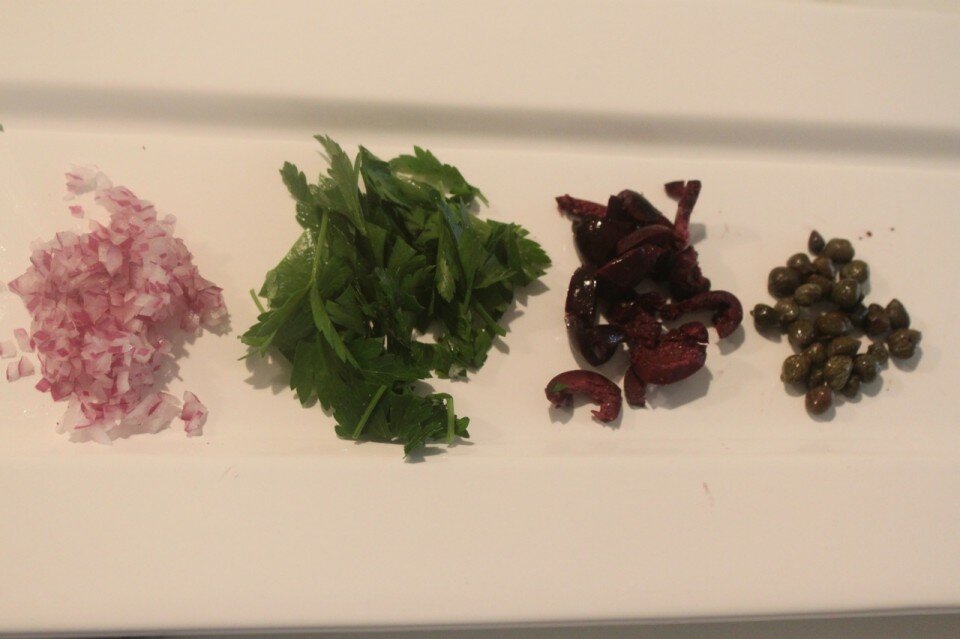
½ cup buttermilk
½ cup sour cream
2 tablespoons capers
2 tablespoons red onion minced
1 tablespoon kalamata or black olives, chopped
2 tablespoons tarragon, minced
2 tablespoons parsley, minced
2 pounds swordfish or bass, skinned
Olive oil
Beefsteak tomato, thinly sliced
Romaine or iceberg lettuce
Portuguese or Kaiser rolls, very lightly toasted
Salt and pepper
- Place sour cream in a medium bowl. Whisk in buttermilk. Adjust if you like a thinner or thicker texture. Fold in capers, red onion, olives, and herbs. Season with salt and pepper. Refrigerate.
- Rub grates thoroughly with olive oil and season fish.
- Grill until done. It should take about 4 minutes per side over a hot direct flame and remove to a platter. Thinly slice or break up into chunks. Spoon dressing on bottom half of bun followed by lettuce, tomato, fish. Close and eat.
Spaghetti Alle Vongole…the right way

Now for one of the more misunderstood and thus poorly done dishes.
Linguine with clam sauce is delicious. Or can be. So is a steak or a burger which you must let rest after cooking so the juices don’t spill out, leaving you with a dry puck. But I’ll eat them anyway, especially with fries and ketchup.
But crummy linguine with clam sauce is a truly inedible disappointment. You can’t eat overdone, rubbery clams, and, more important, a bowl of gray dishwater is wholly offensive.
To pull together the dish you must have three things: 1.) fat to coat the pasta; 2.) plenty of flavor to boost the clams and avoid sea water broth 3.) perfect, even slightly underdone clams.
The universal recipe goes more or less like this: simmer clams in wine and garlic in a covered pot and dump in the pasta. Unfortunately, that process violates the 3 truths above.
So for this recipe, I decided not to screw around and go with folks who’ve been successfully dishing this out for years. In other words, the chefs at Al di La in Brooklyn. Theirs satisfies our formula. The pasta has the fat (1/2 cup olive oil); the denser sauce that just coats the pasta (let it reduce); and the flavor (1/4 cup of garlic). I tossed in more parsley, more clams, and a bit of butter, but essentially it’s the same recipe. The sauce should coat the pasta, leaving just enough at the bottom of the bowl.
Spaghetti Alle Vongole (adapted from The New Brooklyn Cookbook)
Serves 4
3 dozen Manila clams
1 pound spaghetti
½ cup olive oil
1 large shallot minced
4 tablespoons garlic, minced
2 teaspoons crushed red pepper flakes
1 tablespoon dried oregano
1 cup dry white wine
4 tablespoons chopped parsley
2 tablespoons unsalted butter
salt and pepper
- Fill and large bowl with salted water and soak the clams for at least ½ hour. Carefully lift into another bowl leaving the grit behind to discard. Scrub with a brush if necessary, and discard clams that don’t close when tapped and/or are cracked. Rinse the large bowl well.
- Bring a large pot of salted water to bowl and add the pasta.
- Meanwhile, in a large pan over medium-high heat, warm the oil. Add the garlic, shallot, crushed pepper, and oregano. Cook until very fragrant and the garlic is very lightly browned.
- Add the wine and clams and cook over high heat until the clams are just opened and return them to the large bowl. The key is to not overcook or have fully opened shells that may release loose clams in the bowl.
- Continue reducing the sauce halfway. Swirl in the butter and parsley. Add the pasta and toss, season to taste and divide among the bowls. Top each with reserved clams. Serve.